
|
You entered: nearby stars
 APOD: 2024 June 25 Б The Dark Doodad Nebula
25.06.2024
What is that strange brown ribbon on the sky? When observing the star cluster NGC 4372, observers frequently take note of an unusual dark streak nearby running about three degrees in length. The streak, actually a long molecular cloud, has become known as the Dark Doodad Nebula.
 Local Group Galaxy NGC 6822
23.01.2002
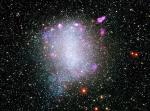
Nearby galaxy NGC 6822 is irregular in several ways. First, the galaxy's star distribution merits a formal classification of dwarf irregular, and from our vantage-point the small galaxy appears nearly rectangular. What strikes...
 Hydrogen Blob N88A in the Small Magellanic Cloud
29.07.1999
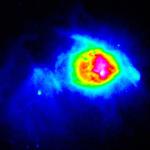
The bright blob of hydrogen gas cataloged as N88A is seen at the right. It measures a mere 3 light years across. Emerging from the cool, dusty interstellar medium in a nearby irregular galaxy known as the Small Magellanic Cloud, N88A hides hot young stars at its core.
 Starburst Galaxy Messier 94
23.10.2015
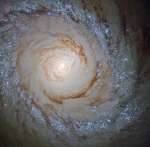
Beautiful island universe Messier 94 lies a mere 15 million light-years distant in the northern constellation of the hunting dogs, Canes Venatici. A popular target for earth-based astronomers, the face-on spiral galaxy is about 30,000 light-years across, with spiral arms sweeping through the outskirts of its broad disk.
 Starburst Galaxy Messier 94
6.03.2025
Beautiful island universe Messier 94 lies a mere 15 million light-years distant in the northern constellation of the hunting dogs, Canes Venatici. A popular target for earth-based astronomers, the face-on spiral galaxy is about 30,000 light-years across, with spiral arms sweeping through the outskirts of its broad disk.
 GW170817: A Spectacular Multiradiation Merger Event Detected
16.10.2017
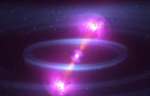
Both gravitational and electromagnetic radiations have been detected in rapid succession for an explosive merging event for the first time. Data from the outburst fit well with a spectacular binary neutron-star death-spiral. The explosive episode was seen on August 17 in nearby NGC 4993, an elliptical galaxy only 130 million light years distant.
 The Hunter s Stars
19.01.2012
Begirt with many a blazing star, Orion, the Hunter, is one of the most easily recognizable constellations. In this night skyscape from January 15, the hunter's stars rise in the northern hemisphere...
 Orion Spring
25.03.2015
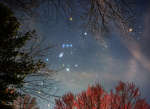
As spring comes to planet Earth's northern hemisphere, familiar winter constellation Orion sets in early evening skies and budding trees frame the Hunter's stars. The yellowish hue of cool red supergiant Alpha Orionis, the great star Betelgeuse, mingles with the branches at the top of this colorful skyscape.
 A Witch by Starlight
31.10.2008
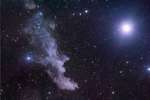
By starlight this eerie visage shines in the dark, a crooked profile evoking its popular name, the Witch Head Nebula. In fact, this entrancing telescopic portrait gives the impression the witch has fixed her gaze on Orion's bright supergiant star Rigel.
 Mediterranean Leonid 2001
7.12.2001
A road trip from Ankara to the Mediterranean coast southeast of Antalya, Turkey found clear skies and splendid scenery for astrophotographer Tunc Tezel's viewing of the 2001 Leonid meteor storm. There he captured this dream-like image of a fireball meteor near the twilit horizon, reflected in calm ocean waters.
|
January February March April May June July August |
||||||||||||||||||||||||||||||||||||||||||||||||||||||||