
|
You entered: space
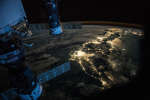 Cities at Night
4.03.2016
Looking toward the south from an altitude of 400 kilometers, this stunning snapshot from orbit finds bright lights of Tokyo and cities across central and southern Japan, planet Earth shining upward through broken clouds. The spacefaring perspective was captured last July by astronaut Scott Kelly during his stay on board the International Space Station.
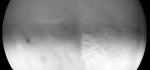 A Global Dust Storm on Mars
1.10.2001
A dust storm on Mars can involve nearly the entire planet. As spring descended on the southern hemisphere of the red planet this June and July, a global dust storm raged. Pictured above is the storm on July 8 as it spread up from the south, oriented on the lower right.
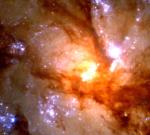 Closeup of Antennae Galaxy Collision
26.10.1997
It's a clash of the titans. Two galaxies are squaring off in Corvus and here are the latest pictures. When two galaxies collide, however, the stars that compose them usually do not. This is because galaxies are mostly empty space and, however bright, stars only take up only a small amount of that space.
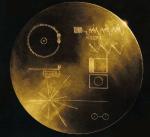 The Voyagers' Message in a Bottle
31.08.2002
Launched twenty-five years ago, NASA's Voyager 1 and 2 spacecraft are now over 10 billion kilometers from the Sun. Still operational, the Voyagers are being tracked and commanded through the Deep Space Network.
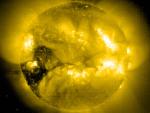 Coronal Holes on the Sun
17.03.2003
The ominous, dark shapes haunting the left side of the Sun are coronal holes -- low density regions extending above the surface where the solar magnetic field opens freely into interplanetary space. Studied extensively from...
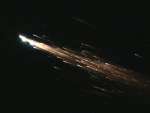 An Extraordinary Voyage
17.10.2008
Nineteenth century science fiction author Jules Verne wrote visionary works about Extraordinary Voyages including tales of space flight and the story of a journey From the Earth to the Moon. Fittingly, the European Space...
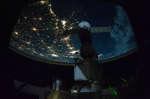 Night Lights
3.11.2010
Constellations of lights sprawl across this night scene, but they don't belong in the skies of planet Earth. Instead, the view looks down from the International Space Station as it passed over the United States along the northern Gulf Coast on October 29. A Russian Soyuz spacecraft is docked in the foreground.
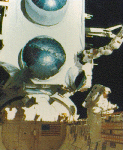 The Compton Observatory Turns Five
13.04.1996
Earlier this April, NASA's Compton Gamma Ray Observatory, completed its fifth successful year in orbit, exploring the gamma ray sky. Pictured is astronaut Jay Apt perched in the shuttle payload bay below the massive observatory. Compton is the largest civilian instrument ever flown - the whole observatory is roughly the size of a school bus.
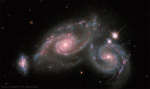 APOD: 2023 January 23 Б The Colliding Spiral Galaxies of Arp 274
22.01.2023
Two galaxies are squaring off in Virgo and here are the latest pictures. When two galaxies collide, the stars that compose them usually do not. This is because galaxies are mostly empty space and, however bright, stars only take up only a small fraction of that space.
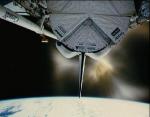 Shuttle Engine Blast
7.03.1998
The Space Shuttle Discovery's orbital maneuvering system (OMS) engine firing produced this dramatic flare as it cruised "upside down" in low Earth orbit. Discovery was named for a ship commanded by Captain James Cook RN, the 18th Century English astronomer and navigator.
|
January February March April May June July August September October |
|||||||||||||||||||||||||||||||||||||||||||||||||