
|
You entered: star
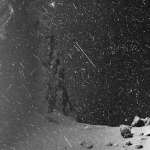 The Snows of Churyumov Gerasimenko
26.04.2018
You couldn't really be caught in this blizzard while standing by a cliff on Churyumov-Gerasimenko, also known as comet 67P. Orbiting the comet in June of 2016 the Rosetta spacecraft's narrow angle...
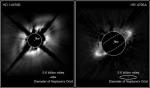 Possible Planets And Infrared Dust
20.01.1999
These near-infrared Hubble images of dust surrounding young stars offer the latest tantalizing evidence for planets beyond our Solar System. At left, the dark gap seen in the dust disk is reminiscent of a similar large gap in Saturn's rings believed to be sculpted by orbiting moons.
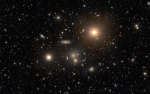 The Hydra Cluster of Galaxies
12.05.2012
Two stars within our own Milky Way galaxy anchor the foreground of this cosmic snapshot. Beyond them lie the galaxies of the Hydra Cluster. In fact, while the spiky foreground stars are hundreds of light-years distant, the Hydra Cluster galaxies are over 100 million light-years away.
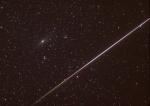 Island Universe, Cosmic Sand
23.08.2002
On August 13, while counting Perseid meteors under dark, early morning Arizona skies, Rick Scott set out to photograph their fleeting but fiery trails. The equipment he used included a telephoto lens and fast color film. After 21 pictures he'd caught only two meteors, but luckily this was one of them.
 APOD: 2024 August 28 Б Tulip Nebula and Black Hole Cygnus X 1
28.08.2024
When can you see a black hole, a tulip, and a swan all at once? At night -- if the timing is right, and if your telescope is pointed in the right direction. The complex and beautiful Tulip Nebula blossoms about 8,000 light-years away toward the constellation of Cygnus the Swan.
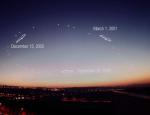 Venus Evening Loop
1.06.2001
From September 2000 through March 2001, astronomer Tunc Tezel patiently photographed the planet Venus on 25 different dates as it wandered through the evening twilight. The pictures were taken from the same spot...
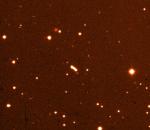 Asteroid 2002 NY40
17.08.2002
Asteroid 2002 NY40 will fly by planet Earth early in the morning August 18 Universal Time (late in the evening August 17 Eastern Daylight Time). Approaching to within about 530,000 kilometers or 1.3 times the Earth-Moon distance 2002 NY40 will definitely not be close enough to pose any danger of collision.
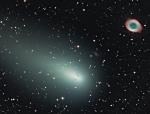 Comet Meets Ring Nebula: Part I
11.05.2006
As dawn approached on May 8, astronomer Stefan Seip carefully watched Fragment C of broken comet 73P/Schwassmann-Wachmann 3 approach M57 - the Ring Nebula, and faint spiral galaxy IC 1296. Of course, even though...
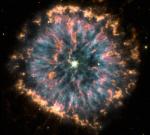 Celebrating Hubble With NGC 6751
7.04.2000
Planetary nebulae do look simple, round, and planet-like in small telescopes. But images from the orbiting Hubble Space Telescope have become well known for showing these fluorescent gas shrouds of dying Sun-like stars to possess a staggering variety of detailed symmetries and shapes.
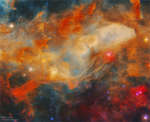 The Blue Horsehead Nebula in Infrared
23.04.2018
The Blue Horsehead Nebula looks quite different in infrared light. In visible light, the reflecting dust of the nebula appears blue and shaped like a horse's head. In infrared light, however, a complex labyrinth of filaments, caverns, and cocoons of glowing dust and gas emerges, making it hard to even identify the equine icon.
|
January February March April May June July August September October |
|||||||||||||||||||||||||||||||||||||||||||||||||