
|
You entered: Earth orbit
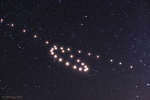 Mars in the Loop
8.11.2018
This composite of images spaced some 5 to 9 days apart, from late April (bottom right) through November 5 (top left), traces the retrograde motion of ruddy-colored Mars through planet Earth's night sky.
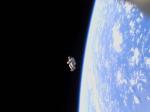 SuitSat1: A Spacesuit Floats Free
20.02.2006
Who dunnit? Like a scene from a space mystery movie, a spacesuit floated away from the International Space Station earlier this month, but no investigation was needed. It was pushed out by the space station crew.
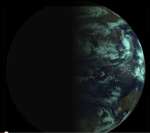 Earth at Equinox
22.09.2014
Earth is at equinox. Over the next 24 hours, day and night have nearly equal duration all over planet Earth. Technically, equinox transpires at 2:29 am Universal Time tomorrow, but this occurs today in North and South America.
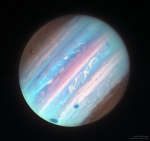 APOD: 2025 November 11 Б Jupiter in Ultraviolet from Hubble
11.11.2025
Jupiter looks a bit different in ultraviolet light. To better interpret Jupiter's cloud motions and to help NASA's robotic Juno spacecraft understand the planetary context of the small fields that it sees, the Hubble Space Telescope was being directed to regularly image the entire Jovian giant.
 Flying Over the Earth at Night II
23.04.2021
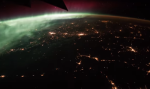
Recorded during 2017, timelapse sequences from the International Space Station are compiled in this serene video of planet Earth at Night. Fans of low Earth orbit can start by enjoying the view as green and red aurora borealis slather up the sky.
 APOD: 2026 August 25 Б Earths Shadow Visualized with Lunar Eclipses
25.08.2026
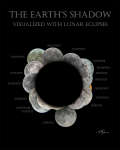
WhatБs creating this giant hole in space? This is not a black hole Б itБs a shadow. ItБs EarthБs shadow. Since at least the time of Aristotle, people have noted that Earth's dark shadow on the Moon during a partial lunar eclipse is circular -- although never a whole circle.
 A Mercury Transit Sequence
27.05.2003
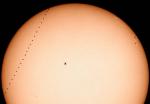
Earlier this month, the planet Mercury crossed the face of the Sun, as seen from Earth. Because the plane of Mercury's orbit is not exactly coincident with the plane of Earth's orbit, Mercury usually appears to pass over or under the Sun.
 The City Comet
26.03.1997
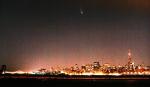
Undaunted by the artificial glow from one of the most famous urban skylines on Earth, comet Hale-Bopp shines above the city of New York, USA. Photographed on March 23rd, this view from New Jersey...
 X-Ray Earth
16.09.2000
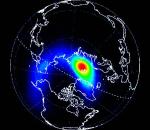
Above is a picture of the Earth in x-rays, taken in March of 1996 from the orbiting Polar satellite. Most of the planet is dark with superposed continent and coordinate grids, while the bright x-ray emission near the north pole is shown in red. Why does the Earth have an x-ray glow?
 A Mercury Transit Sequence
10.11.2019
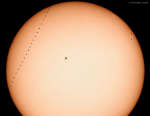
Tomorrow -- Monday -- Mercury will cross the face of the Sun, as seen from Earth. Called a transit, the last time this happened was in 2016. Because the plane of Mercury's orbit is not exactly coincident with the plane of Earth's orbit, Mercury usually appears to pass over or under the Sun.
|
January February March April May June July August September October |
|||||||||||||||||||||||||||||||||||||||||||||||||