
|
You entered: Great Dark Spot
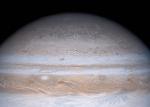 Jupiter s Brain
1.02.2001
Gas giant Jupiter is the solar system's largest world with about 320 times the mass of planet Earth. Famous for its Great Red Spot, Jupiter is also known for its regular, equatorial cloud bands, visible in very modest sized telescopes.
 Jupiter's Clouds from New Horizons
23.10.2011
The New Horizons spacecraft took some stunning images of Jupiter on its way out to Pluto. Famous for its Great Red Spot, Jupiter is also known for its regular, equatorial cloud bands, visible through even modest sized telescopes.
 Stereo Jupiter near Opposition
5.12.2024
Jupiter looks sharp in these two rooftop telescope images. Both were captured last year on November 17 from Singapore, planet Earth, about two weeks after Jupiter's 2023 opposition. Climbing high in midnight skies the giant planet was a mere 33.4 light-minutes from Singapore. That's about 4 astronomical units away.
 Jupiter over 2 Hours and 30 Minutes
19.01.2024
Jupiter, our Solar System's ruling gas giant, is also the fastest spinning planet, rotating once in less than 10 hours. The gas giant doesn't rotate like a solid body though.
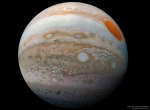 Jupiter Marble from Juno
8.05.2019
What does Jupiter look like up close? Most images of Jupiter are taken from far away, either from Earth or from a great enough distance that nearly half the planet is visible. This shot, though, was composed from images taken relatively close in, where less than half of the planet was visible.
 Jupiter s Clouds from New Horizons
15.10.2007
The New Horizons spacecraft took some stunning images of Jupiter earlier this year while on the way out to Pluto. Famous for its Great Red Spot, Jupiter is also known for its regular, equatorial cloud bands, visible through even modest sized telescopes.
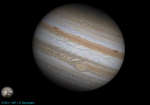 Jupiter Rotates
26.10.2021
Observe the graceful twirl of our Solar System's largest planet. Many interesting features of Jupiter's enigmatic atmosphere, including dark belts and light zones, can be followed in detail. A careful inspection will reveal that different cloud layers rotate at slightly different speeds.
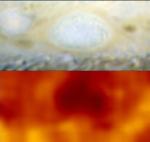 Jupiter: When Storms Collide
22.10.1998
Sometime in February, two of three long-lived Jovian storm systems known as "white ovals" apparently collided and merged -- forming what is now likely the second largest storm in the Solar System, after the famous Great Red Spot.
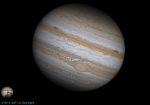 Jupiter Rotation Movie from Pic du Midi
6.12.2011
Observe the graceful twirl of the Solar System's largest planet. Many interesting features of Jupiter's enigmatic atmosphere, including dark bands and light zones, can be followed in detail. A careful inspection will reveal that central clouds rotate slightly faster than clouds toward the poles.
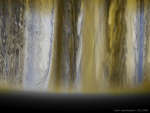 Jupiters Clouds from New Horizons
26.06.2016
The New Horizons spacecraft took some stunning images of Jupiter on its way out to Pluto. Famous for its Great Red Spot, Jupiter is also known for its regular, equatorial cloud bands, visible through even modest sized telescopes.
|
January February March April May June July August September |
|||||||||||||||||||||||||||||||||||||||||||||||||