
|
You entered: Neptune's moon
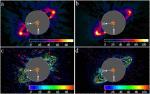 HR 4796A: Not Saturn
5.02.1999
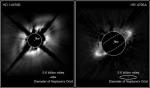
These are not false-color renderings of the latest observations of Saturn's magnificent rings. Instead, the panels show a strikingly similar system on a much larger scale - a ring around the young, Vega-like star, HR 4796A, located about 200 light-years from Earth.
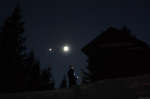 Alpine Conjunction
2.01.2009
Did you see it? The last conjunction of Moon and bright planets in 2008 featured a young crescent Moon and brilliant Venus in the west after sunset on December 31st. Seen here in dark, clear, mountain air from Mönichkirchen, Austria, are the two celestial beacons that dominate planet Earth's night sky.
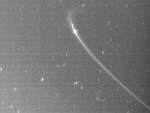 The Anthe Arc around Saturn
10.09.2008
What created this unusual partial ring around Saturn? Discovered last year, the arc was captured in clear detail only two months ago by the Saturn-orbiting Cassini spacecraft. Since the arc occupies the same orbit...
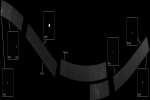 The Solar System from MESSENGER
23.02.2011
If you looked out from the center of the Solar System, what would you see? Nearly such a view was taken recently from the MESSENGER spacecraft currently orbiting the Sun from the distance of Mercury. The Sun's planets all appear as points of light, with the closest and largest planets appearing the brightest.
 Irregular Moons Discovered Around Uranus
3.11.1997
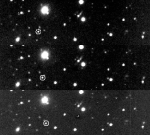
Where did these two irregular moons of Uranus originate? Last week two previously undiscovered moons of the distant gas planet were confirmed, the first in irregular orbits. All fifteen previously known moons of Uranus are 'regular', circling near the planet's equator. Most of these were discovered by the passing Voyager 2 spacecraft in 1986.
 Phoebe: Comet Moon of Saturn
30.06.2004
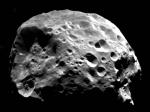
Was Saturn's moon Phoebe once a comet? Images from the robotic Cassini spacecraft taken two weeks ago when entering the neighborhood of Saturn indicate that Phoebe may have originated in the outer Solar System.
 Jupiter's Rings
2.08.1995
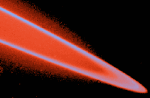
Astronomers using NASA's Voyager spacecraft to search for a ring system around Jupiter discovered these faint rings in 1979. Unlike Saturn's bright rings which are composed of chunks of rock and ice, Jupiter's rings appear to consist of fine particles of dust.
 Phoebe: Comet Moon of Saturn
12.02.2006
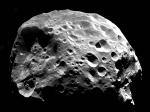
Was Saturn's moon Phoebe once a comet? Images from the robotic Cassini spacecraft taken two years ago when entering the neighborhood of Saturn indicate that Phoebe may have originated in the outer Solar System.
 Possible Planets And Infrared Dust
20.01.1999
These near-infrared Hubble images of dust surrounding young stars offer the latest tantalizing evidence for planets beyond our Solar System. At left, the dark gap seen in the dust disk is reminiscent of a similar large gap in Saturn's rings believed to be sculpted by orbiting moons.
 Triton: Neptunes Largest Moon
4.03.2007
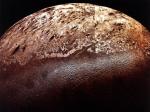
In October of 1846, William Lassell was observing the newly discovered planet Neptune. He was attempting to confirm his observation, made just the previous week, that Neptune had a ring. But this time he discovered that Neptune had a satellite as well.
|
January February March April May June July August September |
|||||||||||||||||||||||||||||||||||||||||||||||||