
|
You entered: Rigel
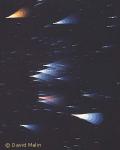 Orion Star Colours
29.08.1998
What determines a star's colour? Its temperature. Red stars are cool, around 3,000 kelvins (K), while blue stars are hotter and can have temperatures over 30,000 K. Our own lovely yellow Sun's temperature is a comforting 6,000 K.
 NGC 1788 and the Witch s Whiskers
19.04.2013
This skyscape finds an esthetic balance of interstellar dust and gas residing in the suburbs of the nebula rich constellation of Orion. Reflecting the light of bright star Rigel, Beta Orionis, the jutting, bluish chin of the Witch Head Nebula is at the upper left.
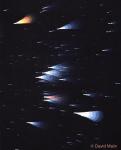 Orion's Star Colors
2.12.1996
What determines a star's color? Its temperature. Red stars are cool, with temperatures of around 3,000 degrees Kelvin (K), while blue stars are hotter and can have temperatures over 30,000 degrees K. Our own lovely yellow Sun's temperature is a comforting 6,000 degrees K.
 A December Winter Night
28.12.2024
Orion seems to come up sideways, climbing over a distant mountain range in this deep skyscape. The wintry scene was captured from southern Poland on the northern hemisphere's long solstice night. Otherwise unseen nebulae hang in the sky, revealed by the camera modified to record red hydrogen-alpha light.
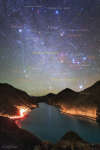 Winter Hexagon over Manla Reservoir
23.01.2017
If you can find Orion, you might be able to find the Winter Hexagon. The Winter Hexagon involves some of the brightest stars visible, together forming a large and easily found pattern in the winter sky of Earth's northern hemisphere.
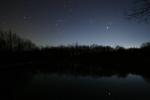 Venus by the Lake
14.04.2007
Finding Venus in the night sky is not too hard these days. Now appearing as the evening star, Venus rules as the brightest celestial beacon in west just after sunset. And if you can find Venus tonight, you can also easily find the lovely Pleiades star cluster (aka M45) close by.
 Outbound Comet ZTF
24.03.2023
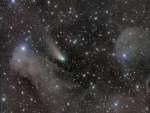
Former darling of the northern sky Comet C/2022E3 (ZTF) has faded. During its closest approach to our fair planet in early February Comet ZTF was a mere 2.3 light-minutes distant. Then known as the green comet, this visitor from the remote Oort Cloud is now nearly 13.3 light-minutes away.
 Winter Hexagon Over Stagecoach Colorado
3.01.2011
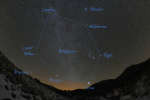
If you can find Orion, you might be able to find the Winter Hexagon. The Winter Hexagon involves some of the brightest stars visible, together forming a large and easily found pattern in the winter sky of Earth's northern hemisphere.
 Mars and Orion Over Monument Valley
25.12.2007
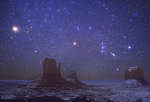
Welcome to The World At Night. Sharing the night sky seen around the world, this view from Monument Valley, USA includes a picturesque foreground of famous buttes. Buttes are composed of hard volcanic rock left behind after water eroded away the surrounding soft rock.
 Orion Over and Under Tibet
5.10.2015
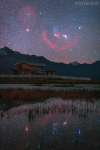
This night was so serene you could see Orion rise downwards. The unusual spectacle was captured in this single-exposure image, featuring a deep sky around the famous constellation of Orion that appeared both above -- and reflected in -- a peaceful lake in the Gyirong Valley of Tibet, China.
|
January February March April May June July August |
||||||||||||||||||||||||||||||||||||||||||||||||||||||||