
|
You entered: Voyager 2
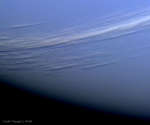 Two Hours Before Neptune
14.02.2015
Two hours before closest approach to Neptune in 1989, the Voyager 2 robot spacecraft snapped this picture. Clearly visible for the first time were long light-colored cirrus-type clouds floating high in Neptune's atmosphere. Shadows of these clouds can even be seen on lower cloud decks.
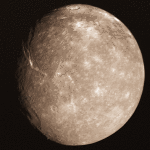 Uranus' Largest Moon: Titania
3.03.1996
Titania's tortured terrain is a mix of valleys and craters. NASA's interplanetary robot spacecraft Voyager 2 passed this moon of Uranus in 1986 and took the above photograph. The photograph was then transmitted back to earth by radio.
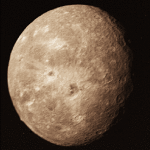 Uranus's Moon Oberon: Impact World
8.04.1996
Oberon is the most distant and second largest moon of Uranus. Discovered by William Herschel in 1787, the properties of the world remained relatively unknown until the robot spacecraft Voyager 2 passed it during its flyby of Uranus in January 1986.
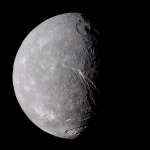 APOD: 2026 March 31 Б Uranus Largest Moon: Titania
30.03.2026
Titania's tortured terrain is a mix of canyons, cliffs, and craters. NASA's interplanetary robot spacecraft Voyager 2 passed the largest moon of Uranus in 1986 and took the feature picture. That...
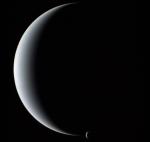 Crescent Neptune and Triton
19.06.2001
Gliding silently through the outer Solar System, the Voyager 2 spacecraft camera captured Neptune and Triton together in crescent phase in 1989. The above picture of the gas giant planet and its cloudy moon was taken from behind just after closest approach.
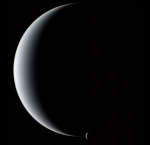 Crescent Neptune and Triton
14.04.2013
Gliding silently through the outer Solar System, the Voyager 2 spacecraft camera captured Neptune and Triton together in crescent phase in 1989. The elegant picture of the gas giant planet and its cloudy moon was taken from behind just after closest approach.
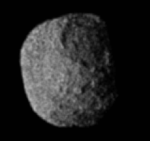 Neptune's Moon Proteus
3.11.1995
Proteus is the second largest moon of Neptune behind the mysterious Triton. Proteus was discovered only in 1982 by the Voyager 2 spacecraft. This is unusual since Neptune has a smaller moon - Nereid - which was discovered 33 years earlier from Earth.
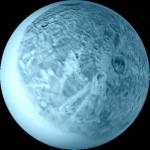 Hamlet of Oberon
30.01.1997
What's in a name? Since 1919, the International Astronomical Union has been charged with the task of establishing "conventional" nomenclature for planets, satellites, and surface features. For the remote Uranian system of moons, namesakes from Shakespearean works have been chosen.
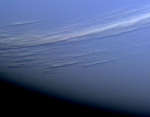 Two Hours Before Neptune
8.08.2010
Two hours before closest approach to Neptune in 1989, the Voyager 2 robot spacecraft snapped this picture. Clearly visible for the first time were long light-colored cirrus-type clouds floating high in Neptune's atmosphere. Shadows of these clouds can even be seen on lower cloud decks.
 APOD: 2025 September 1 Б Callisto: Dirty Battered Iceball
31.08.2025
Its surface is the most densely cratered in the Solar System -- but what's inside? Jupiter's moon Callisto is a battered ball of dirty ice that is larger than the planet Mercury.
|
January February March April |
|||||||||||||||||||||||||||||||||||||||||||||||||