
|
You entered: ecliptic
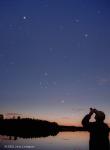 Dusk of the Planets
29.04.2002
A great grouping of planets is now visible to the west just after sunset. Over the next two weeks, Mercury, Venus, Earth, Mars, Jupiter, and Saturn -- all the planets of the inner Solar System -- can be seen in a single knowing glance. The image on the left captured them all in one frame.
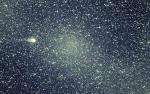 The Gegenschein
25.06.1999
If you look carefully enough, you can even see the glow of the Sun in the opposite direction. At night this glow is known as the gegenschein (German for "counter glow"), and can be seen as a faint glow in an extremely dark sky, as pictured above.
 A Jupiter Venus Conjunction
8.03.1999
Venus and Jupiter appeared unusually close together in the sky last month. The conjunction was easily visible to the unaided eye because Venus appears brighter than any background star. The two planets were not significantly closer in space - Venus just passed nearly in front of Jupiter as seen from the Earth.
 A Five Planet Dawn
30.01.2016
As January closes and in the coming days of February, early morning risers can spot the five naked-eye planets before dawn. Though some might claim to see six planets, in this seaside panoramic view all five celestial wanderers were found above the horizon along with a bright waning gibbous Moon on January 27.
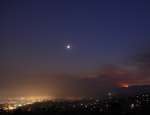 Planets and Fire by Moonlight
9.07.2008
On July 5th, wandering planets, bright stars, and a young crescent Moon graced western skies after sunset. Arrayed along the solar system's ecliptic plane, the three celestial beacons forming this skyscape's eye-catching line-up with the Moon are Saturn (upper left), then Mars, and finally Regulus, alpha star of the constellation Leo.
 Mars, Antares, Moon, and Saturn
4.10.2014
Mars, Antares, Moon, and Saturn are the brightest celestial beacons in this serene sky. The Sun's golden light is still scattered along the southwestern horizon though, captured after sunset on September 28.
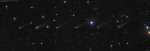 Rosetta and Comet Outbound
28.11.2015
Not a bright comet, 67P/Churyumov-Gerasimenko now sweeps slowly through planet Earth's predawn skies near the line-up of planets along the ecliptic. Still, this composite of telescopic images follows the comet's progress as it moves away from the Sun beyond the orbit of Mars, from late September (left) through late November (far right).
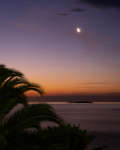 Crescent Moon Occultation
25.02.2023
On February 22, a young Moon shared the western sky at sunset with bright planets Venus and Jupiter along the ecliptic plane. The beautiful celestial conjunction was visible around planet Earth. But from some locations Jupiter hid for a while, occulted by the crescent lunar disk.
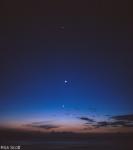 March of the Planets
25.03.1999
This March stargazers have been treated to eye-catching formations of bright planets in western evening skies. On March 3rd, looking toward a beautiful sunset from a beach on the Hawaiian isle of Maui, photographer Rick Scott recorded this fleeting, four-planet "hockey stick" array.
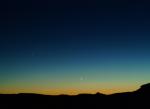 Planets in the West
24.06.2005
This weekend three planets will grace the western sky, forming a lovely trio easily visible shortly after sunset. Saturday evening in particular will find Saturn, Venus, and Mercury all within a 2 degree circle (about the size of your thumb held at arm's length) above the western horizon.
|
January February March April May June July August September October |
|||||||||||||||||||||||||||||||||||||||||||||||||