
|
You entered: emission nebula
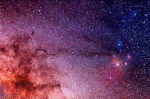 The Pipe Dark Nebula
21.06.1997
The dark nebula predominant at the lower left of the above photograph is known as the Pipe Nebula. The dark clouds, suggestively shaped like smoke rising from a pipe, are caused by absorption of background starlight by dust.
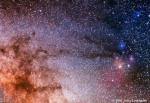 The Pipe Dark Nebula
5.03.2000
The dark nebula predominant at the lower left of the above photograph is known as the Pipe Nebula. The dark clouds, suggestively shaped like smoke rising from a pipe, are caused by absorption of background starlight by dust.
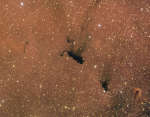 Molecular Cloud Barnard 163
1.05.2011
It may look to some like a duck, but it lays stars instead of eggs. In the center of the above image lies Barnard 163, a nebula of molecular gas and dust so thick that visible light can't shine through it.
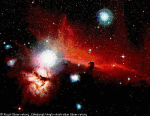 Orion's Horsehead Nebula
2.10.1996
The Horsehead Nebula is arguably the most famous nebula on the sky. It is visible as the black indentation to the red emission nebula seen just to the right of center of the above photograph. The bright star near the center is located in the belt of the familiar constellation of Orion.
 APOD: 2025 September 2 Б The Horsehead and Flame Nebulas
2.09.2025
The Horsehead Nebula is one of the most famous nebulae on the sky. It is visible as the dark indentation to the orange emission nebula at the far right of the featured picture. The horse-head feature is dark because it is really an opaque dust cloud that lies in front of the bright emission nebula.
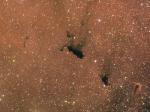 Molecular Cloud Barnard 163
21.03.2007
It may look to some like a duck, but it lays stars instead of eggs. In the center of the above image lies Barnard 163, a nebula of molecular gas and dust so thick that visible light can't shine through it.
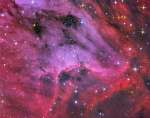 Pelican Nebula Close Up
19.08.2010
The prominent ridge of emission featured in this intensely colorful skyscape is designated IC 5067. Part of a larger emission nebula with a distinctive shape, popularly called The Pelican Nebula, the ridge spans about 10 light-years and follows the curve of the cosmic pelican's head and neck.
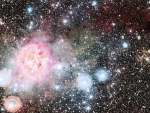 The Cocoon Nebula from CFHT
14.01.2008
What creates the colors of the Cocoon Nebula? The Cocoon Nebula, cataloged as IC 5146, is a strikingly beautiful nebula located about 4,000 light years away toward the constellation of the Swan (Cygnus). Inside the Cocoon Nebula is a newly developing open cluster of stars.
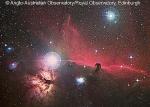 Orion's Horsehead Nebula
27.08.2000
The Horsehead Nebula is one of the most famous nebulae on the sky. It is visible as the black indentation to the red emission nebula seen just to the right of center of the above photograph. The bright star near the center is located in the belt of the familiar constellation of Orion.
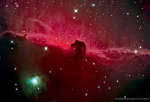 The Horsehead Nebula
31.12.2013
The Horsehead Nebula is one of the most famous nebulae on the sky. It is visible as the dark indentation to the red emission nebula in the center of the above photograph. The horse-head feature is dark because it is really an opaque dust cloud that lies in front of the bright red emission nebula.
|
January February March April May June July August September October |
|||||||||||||||||||||||||||||||||||||||||||||||||