
|
You entered: halo
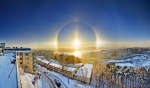 A Sun Halo Beyond Stockholm
10.01.2011
What's happened to the Sun? Sometimes it looks like the Sun is being viewed through a large lens. In the above case, however, there are actually millions of lenses: ice crystals. As water freezes in the upper atmosphere, small, flat, six-sided, ice crystals might be formed.
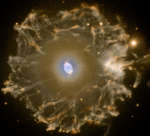 Halo of the Cats Eye
1.06.2014
The Cat's Eye Nebula (NGC 6543) is one of the best known planetary nebulae in the sky. Its haunting symmetries are seen in the very central region of this stunning false-color picture, processed...
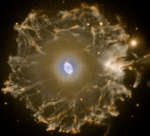 Halo of the Cats Eye
7.06.2020
The Cat's Eye Nebula (NGC 6543) is one of the best known planetary nebulae in the sky. Its haunting symmetries are seen in the very central region of this stunning false-color picture, processed...
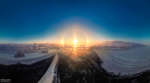 Sun Halo at Sixty three Degrees North
21.12.2022
Happy Solstice! Today is the December solstice, marking an astronomical beginning of summer in the southern hemisphere and winter in the north. On its yearly trek through planet Earth's skies, at this solstice the Sun reaches its southern most declination, 23.5 degrees south, at 21:48 UTC.
 Circular Sun Halo
14.10.2023
Want to see a ring around the Sun? It's easy to do in daytime skies around the world. Created by randomly oriented ice crystals in thin high cirrus clouds, circular 22 degree halos are visible much more often than rainbows.
 Halo from Atacama
18.05.2016
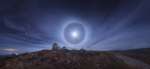
Influenced by the strong Pacific El Nino, cloudy skies have more often come to Chile's high Atacama Desert this season, despite its reputation as an astronomer's paradise. Located...
 Halo of the Cat s Eye
31.08.2012
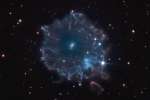
The Cat's Eye Nebula (NGC 6543) is one of the best known planetary nebulae in the sky. Its haunting symmetries are seen in the very central region of this tantalizing image, processed to reveal the enormous but extremely faint halo of gaseous material, about 6 light-years across, which surrounds the brighter, familiar planetary nebula.
 Sun Halo at Winter Solstice
14.01.2002
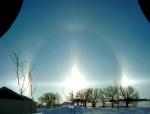
Sometimes it looks like the Sun is being viewed through a large lens. In the above case, however, there are actually millions of lenses: ice crystals. As water freezes in the upper atmosphere, small, flat, six-sided, ice crystals might be formed.
 Sun Halo over Sweden
1.01.2018
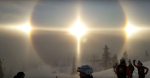
What's happened to the Sun? Sometimes it looks like the Sun is being viewed through a giant lens. In the featured video, however, there are actually millions of tiny lenses: ice crystals. Water may freeze in the atmosphere into small, flat, six-sided, ice crystals.
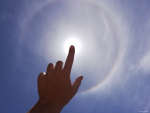 Circular Sun Halo
10.06.2021
Want to see a ring around the Sun? It's easy to do in daytime skies around the world. Created by randomly oriented ice crystals in thin high cirrus clouds, circular 22 degree halos are visible much more often than rainbows. This one was captured by smart phone photography on May 29 near Rome, Italy.
|
January February March April May June July August September October |
|||||||||||||||||||||||||||||||||||||||||||||||||