
|
You entered: loops
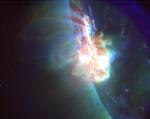 An Active Region of the Sun
16.06.1998
The Sun is a busy place. This false-color image depicts an active region near an edge of the Sun. Hot plasma is seen exploding off the Sun's photosphere and traveling along loops defined by the Sun's magnetic field.
 Solar Magnetic Bananas
29.06.1998
Is that our Sun? The unusual banana-shaped loops shown above are actually part of a computer-generated snap-shot of our Sun's magnetic field. This animated frame was constructed using data from the ground-based U.S. Solar Vector Magnetograph and the space-based Japanese X-Ray Telescope Yohkoh.
 Jupiter and Saturn Pas de Deux
20.12.2001
Viewed from Earth, the solar system's planets do a cosmic dance that is hard to appreciate on any single night. But consider this well planned animated sequence combining 23 pictures taken at approximately 2 week intervals from June 2000 through May 2001.
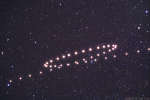 Retrograde Mars
13.06.2010
Why would Mars appear to move backwards? Most of the time, the apparent motion of Mars in Earth's sky is in one direction, slow but steady in front of the far distant stars. About every two years, however, the Earth passes Mars as they orbit around the Sun.
 Retrograde Mars
11.05.2008
Why would Mars appear to move backwards? Most of the time, the apparent motion of Mars in Earth's sky is in one direction, slow but steady in front of the far distant stars. About every two years, however, the Earth passes Mars as they orbit around the Sun.
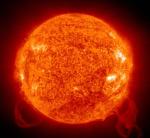 Double Eruptive Prominences
18.04.2003
Lofted over the Sun on looping magnetic fields, large solar prominences are composed of relatively cool, dense plasma. When seen against the brilliant solar disk they appear as dark filaments, but these enormous magnetic...
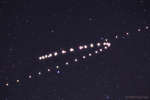 Retrograde Mars
27.10.2014
Why would Mars appear to move backwards? Most of the time, the apparent motion of Mars in Earth's sky is in one direction, slow but steady in front of the far distant stars. About every two years, however, the Earth passes Mars as they orbit around the Sun.
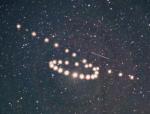 Retrograde Mars
16.12.2003
Why would Mars appear to move backwards? Most of the time, the apparent motion of Mars in Earth's sky is in one direction, slow but steady in front of the far distant stars. About every two years, however, the Earth passes Mars as they orbit around the Sun.
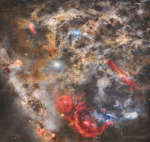 APOD: 2026 March 2 Б The Dusty Surroundings of Orion and the Pleiades
2.03.2026
How well do you know the night sky? OK, but how well can you identify famous sky objects in a very deep image? Either way, here is a test: see if you can find some well-known night-sky icons in a deep image filled with filaments of normally faint dust and gas.
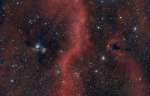 Decorating the Sky
25.12.2010
Bright stars, clouds of dust and glowing nebulae decorate this cosmic scene, a skyscape just north of Orion's belt. Close to the plane of our Milky Way Galaxy, the wide field view spans about 5.5 degrees. Striking bluish M78, a reflection nebula, is at the left.
|
January February March April May June July August September |
|||||||||||||||||||||||||||||||||||||||||||||||||