
|
You entered: planetary nebula
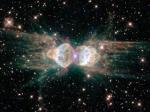 Planetary Nebula Mz3: The Ant Nebula
1.05.2005
Why isn't this ant a big sphere? Planetary nebula Mz3 is being cast off by a star similar to our Sun that is, surely, round. Why then would the gas that is streaming away create an ant-shaped nebula that is distinctly not round?
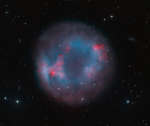 Planetary Nebula Abell 7
23.01.2026
Very faint planetary nebula Abell 7 is about 1,800 light-years distant. It lies just south of Orion in planet Earth's skies toward the constellation Lepus, The Hare. Posing with scattered Milky Way stars, its generally simple spherical shape about 8 light-years in diameter is revealed in this deep telescopic image.
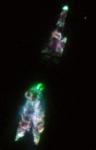 Emerging Planetary Nebula CRL 618
6.09.2000
CRL 618 may look to some like an Olympian declaring victory. Only a few hundred years ago, however, CRL 618 appeared as a relatively modest red giant star. Since then it has run out of core material to fuse and so has started to become a planetary nebula.
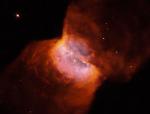 NGC 2346: A Butterfly Shaped Planetary Nebula
12.10.1999
It may look like a butterfly, but it's bigger than our Solar System. NGC 2346 is a planetary nebula made of gas and dust that has evolved into a familiar shape. At the heart of the bipolar planetary nebula is a pair of close stars orbiting each other once every sixteen days.
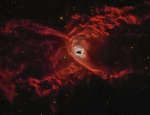 The Red Spider Planetary Nebula
29.10.2012
Oh what a tangled web a planetary nebula can weave. The Red Spider Planetary Nebula shows the complex structure that can result when a normal star ejects its outer gases and becomes a white dwarf star.
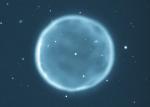 Spherical Planetary Nebula Abell 39
23.01.2001
One of the largest spheres in our Galaxy is giving valuable clues about the chemical composition of stars by its very shape. Planetary nebula Abell 39, now six light-years across, was once a sun-like star's outer atmosphere expelled thousands of years ago.
 APOD: 2024 April 30 Б GK Per: Nova and Planetary Nebula
30.04.2024
The star system GK Per is known to be associated with only two of the three nebulas pictured. At 1500 light years distant, Nova Persei 1901 (GK Persei) was the second closest nova yet recorded. At the very center is a white dwarf star, the surviving core of a former Sun-like star.
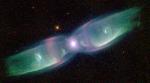 M2-9: Wings of a Planetary Nebula
23.12.1997
Are stars better appreciated for their art after they die? Actually, stars usually create their most artistic displays as they die. In the case of low-mass stars like our Sun and M2-9 pictured above, the stars transform themselves from normal stars to white dwarfs by casting off their outer gaseous envelopes.
 Planetary Nebula Mz3: The Ant Nebula
25.04.2010
Why isn't this ant a big sphere? Planetary nebula Mz3 is being cast off by a star similar to our Sun that is, surely, round. Why then would the gas that is streaming away create an ant-shaped nebula that is distinctly not round?
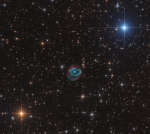 Planetary Nebula Abell 78
16.10.2020
Planetary nebula Abell 78 stands out in this colorful telescopic skyscape. In fact the colors of the spiky Milky Way stars depend on their surface temperatures, both cooler (yellowish) and hotter (bluish) than the Sun.
|
January February March April May June July August September October |
|||||||||||||||||||||||||||||||||||||||||||||||||