
|
You entered: redshift
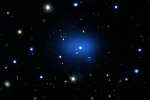 JKCS041: The Farthest Galaxy Cluster Yet Measured
28.10.2009
What if we could see back to the beginning of the universe? We can -- since it takes the age of the universe for light to cross the universe. Peering at distant objects, therefore, tells us about how the universe used to be, even near its beginning.
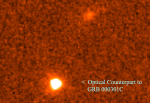 A GRB 000301C Symphony
3.06.2001
Last March, telescopic instruments in Earth and space tracked a tremendous explosion that occurred across the universe. A nearly unprecedented symphony of international observations began abruptly on 2000 March 1 when Earth-orbiting RXTE, Sun-orbiting Ulysses, and asteroid-orbiting NEAR all detected a 10-second burst of high-frequency gamma radiation. Within 48 hours astronomers
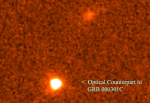 A GRB 000301C Symphony
14.03.2000
Telescopic instruments in Earth and space are still tracking a tremendous explosion that occurred across the universe. A nearly unprecedented symphony of international observations began abruptly on March 1 when Earth-orbiting RXTE, Sun-orbiting Ulysses, and asteroid-orbiting NEAR all detected a 10-second burst of high-frequency gamma radiation.
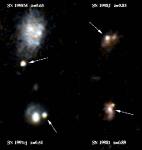 The Year of Distant Supernovae
31.12.1998
Distant supernovae were among topics at the forefront of astronomy during 1998. Two independent groups raced to deploy large telescopes to scan the sky, discovering and analyzing far-off supernovae with the promise of calibrating the geometry of our universe.
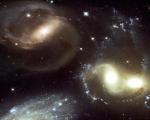 Disorder in Stephan's Quintet
13.11.2000
What are four closely grouped galaxies doing in this image? The grouping composes a majority of the large galaxies in Stephan's Quintet, with the fifth prominent galaxy located off the above image to the lower right.
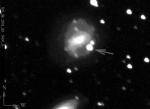 A Gamma Ray Burst Supernova
8.05.1998
Did a gamma-ray burst precede this supernova? This intriguing suggestion came to light yesterday with the discovery of an evolving supernova that is potentially coincident with the position of gamma-ray burst GRB 980425, which occurred just two weeks ago. If true, this would tie together the two most violent phenomena known in the universe.
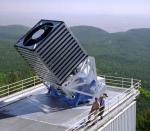 The Sloan Digital Sky Survey Telescope
17.06.1998
The Sloan Digital Sky Survey (SDSS) will soon begin. Pictured above is the 2.5-meter telescope poised to create the most ambitious sky map in the history of astronomy. SDSS will catalog one quarter of the sky down past 23rd magnitude ( R), obtaining redshifts for galaxies and quasars brighter than magnitude 19.
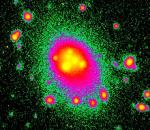 A3827: Cluster Cannibal
31.08.1998
It was mealtime in galaxy cluster Abell 3827. The hungry cluster dominant galaxy in A3827's center is seen being fed. Breakfast included five smaller galaxies unfortunate enough to wander too close to the cluster's central supergiant galaxy. The remnants of these five galaxies can be seen in the center of this false-color picture.
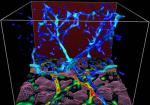 A Universe in a Box
21.08.1997
Is this our universe? Possibly. It is one computerized guess of how gas in the universe was distributed billions of years ago, at redshift 3, when the universe was only a quarter of its present age.
 COBE Dipole: Speeding Through the Universe
9.02.2003
Our Earth is not at rest. The Earth moves around the Sun. The Sun orbits the center of the Milky Way Galaxy. The Milky Way Galaxy orbits in the Local Group of Galaxies. The Local Group falls toward the Virgo Cluster of Galaxies.
|
January February March April May June July August September |
|||||||||||||||||||||||||||||||||||||||||||||||||