
|
You entered: seasons
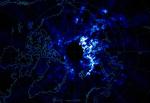 Night Shining Clouds
5.07.2007
Alluring noctilucent or night-shining clouds lie near the edge of space, some 80 kilometers above Earth's surface. Of course, when viewed from space the clouds are more properly called polar mesospheric clouds (PMCs) -- seen here for the first time in image data from the Aeronomy of Ice in the Mesosphere (AIM) satellite.
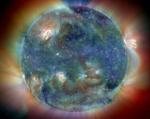 Solstice Celebration
20.06.2004
Season's greetings! Today or tomorrow, depending on your time zone, the Sun reaches its northernmost point in planet Earth's sky marking a season change and the first solstice of the year 2004. In celebration, consider this delightfully detailed, brightly colored image of the active Sun.
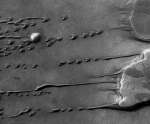 Flowing Barchan Sand Dunes on Mars
22.04.2012
When does Mars act like a liquid? Although liquids freeze and evaporate quickly into the thin atmosphere of Mars, persistent winds may make large sand dunes appear to flow and even drip like a liquid.
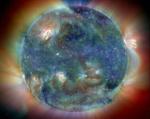 Solstice Celebration
21.12.2002
Aloha and Season's greetings! On December 22nd, at 01:14 Universal Time (December 21, 3:14pm Hawaii-Aleutian Standard Time), the Sun reaches its southernmost point in planet Earth's sky marking the final season change for the year 2002. In celebration, consider this delightfully detailed, brightly colored image of the active Sun.
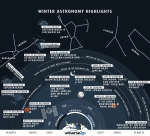 Highlights of the North Winter Sky
5.12.2018
What can you see in the night sky this season? The featured graphic gives a few highlights for Earth's northern hemisphere. Viewed as a clock face centered at the bottom, early (northern) winter sky events fan out toward the left, while late winter events are projected toward the right.
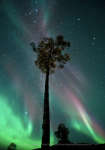 September Aurora
21.09.2012
September's equinox arrives tomorrow as the Sun crosses the celestial equator heading south. The event marks the astronomical beginning of spring in the southern hemisphere and autumn in the north. And though the connection is still puzzling, the equinox seasons bring an increase in geomagnetic storms.
 APOD: 2026 August 5 Б Spokes on Saturn's B Ring
5.08.2026
DonБt get spooked by SaturnБs ghostly spokes! Today we feature a nearly two-hour timelapse of Saturn and its rings looping forwards and backwards. A day on Saturn is only 10 hours long, so two hours of observation covers quite a bit of its rotation.
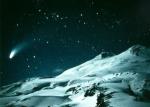 A Hale Bopp Holiday
25.12.1997
Seen from the Pik Terskol Observatory in the northern Caucasus mountains, comet Hale-Bopp and the bright stars of the constellation Perseus hang above the snowy, moon-lit landscape. Although it reminds Northern Hemisphere dwellers of an idyllic Winter scene, this picture was actually recorded in the spring - on April 13th of this year.
 Neptune: Once Around
14.07.2011
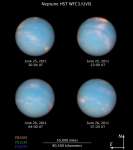
Neptune rotates once on its axis in about 16 hours. So, spaced about 4 hours apart these 4 images of the solar system's most distant gas giant cover one Neptune day. Recorded...
 Nebulae For Christmas
25.12.1998
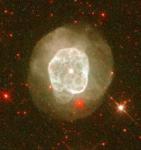
If our Galaxy were a Christmas tree, planetary nebulae would adorn it like colorful lighted ornaments twinkling on a cosmic scale. Glowing shrouds of gas ejected by red giant stars, planetary nebulae like...
|
January February March April May June July August |
||||||||||||||||||||||||||||||||||||||||||||||||||||||||