
|
You entered: ultraviolet
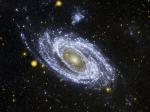 Bright Spiral Galaxy M81 in Ultraviolet from Galex
15.05.2007
Where are the hot stars in M81, one of the closest major spiral galaxies? To help find out, astronomers took a deep image in ultraviolet light of the sprawling spiral with the Earth-orbiting Galex telescope.
 Astro 2 In Orbit
16.03.2001
Six years ago, a cluster of three ultraviolet telescopes flew into orbit on the Astro-2 mission aboard the space shuttle Endeavour. Seen here perched in Endeavour's payload bay about 350 kilometers above the Australian desert are the Hopkins Ultraviolet Telescope (HUT), the Ultraviolet Imaging Telescope (UIT), and the Wisconsin Ultraviolet Photo-Polarimeter Experiment (WUPPE).
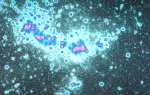 LMC Star Clouds
10.10.1995
Pictured above are clouds of young stars forming an arc in the nearby Large Magellanic Cloud, the nearest galaxy to the our Milky Way Galaxy. These stars are situated in a star forming region known as N 51.
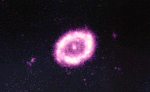 Starburst Galaxy M94
15.10.1995
The spiral galaxy M94 is somewhat unusual in that it shows a great ring of bright young stars particularly apparent when observed in ultraviolet light, as shown above. Such a high abundance of these young blue stars may cause a galaxy to be designated a starburst galaxy.
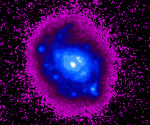 M77: Spiral with a Strange Glow
10.09.1996
Why is M77 surrounded by an ultraviolet glow? M77, also called NGC 1068, appears at first sight to be a relatively normal barred spiral galaxy. But when photographed in the ultraviolet (UV), as shown above in false color, the galaxy sports an ultraviolet halo - shown as violet in the photograph.
 Globular Cluster Omega Centauri
15.10.2000
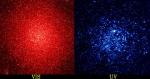
Does an old, red globular cluster have any hot, blue stars? The rightmost picture, taken by the Ultraviolet Imaging Telescope in ultraviolet light, shows that indeed it does. Pictured, Omega Centauri is the largest known globular cluster of over 200 in our Galaxy, containing well over a million stars.
 Globular Cluster Omega Centauri
4.10.1996
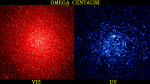
Does an old, red globular cluster have any hot, blue stars? The rightmost picture, taken by the Ultraviolet Imaging Telescope in ultraviolet light, shows that indeed it does. Pictured, Omega Centauri is the largest known globular cluster in our Galaxy, containing well over a million stars.
 EUVE Sky Map
30.01.2002
The stars beyond the Sun and the distant galaxies should be undetectable at extreme ultraviolet wavelengths. At least that was the conventional wisdom when it was first realized that the space between the stars is filled with hydrogen, a strong absorber of extreme ultraviolet light.
 Hole in the Sun
27.09.2007
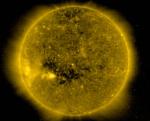
The dark expanse below the equator of the Sun is a coronal hole -- a low density region extending above the surface where the solar magnetic field opens freely into interplanetary space. Shown in false color, the picture was recorded on September 19th in extreme ultraviolet light by the EIT instrument onboard the space-based SOHO observatory.
 SDO s Multiwavelength Sun
21.12.2013
Today, the solstice is at 17:11 Universal Time, the Sun reaching the southernmost declination in its yearly journey through planet Earth's sky. The December solstice marks the astronomical beginning of winter in the northern hemisphere and summer in the south.
|
January February March April May June July August September October |
|||||||||||||||||||||||||||||||||||||||||||||||||