
|
You entered: water-ice
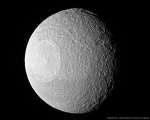 Odysseus Crater on Tethys
5.02.2017
Some moons wouldn't survive the collision. Tethys, one of Saturn's larger moons at about 1000 kilometers in diameter, survived the collision, but today exhibits the resulting expansive impact crater Odysseus. Sometimes called...
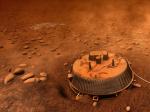 Huygens on Titan Illustrated
31.01.2006
If you could stand on Titan, what might you see? About one year ago the robotic Huygens probe landed on the enigmatic moon of Saturn and sent back the first ever images from beneath Titan's thick cloud layers.
 APOD: 2024 December 3 Б Ice Clouds over a Red Planet
3.12.2024
If you could stand on Mars -- what might you see? You might look out over a vast orange landscape covered with rocks under a dusty orange sky, with a blue-tinted Sun setting over the horizon, and odd-shaped water clouds hovering high overhead.
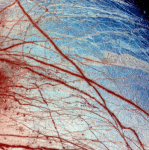 The Cracked Ice Plains of Europa
22.10.1996
What caused the cracks in this giant ice-ball? Jupiter's moon Europa has smoothest surface in the solar system and is composed mostly of cracked water-ice. In the above false-colored picture released last week...
 Southern Moonscape
30.08.2024
The Moon's south pole is toward the top left of this detailed telescopic moonscape. Captured on August 23, it looks across the rugged southern lunar highlands. The view's foreshortened perspective heightens the impression of a dense field of craters and makes the craters themselves appear more oval shaped close to the lunar limb.
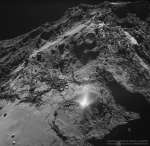 A Dust Jet from the Surface of Comet 67P
6.11.2017
Where do comet tails come from? There are no obvious places on the nuclei of comets from which the jets that create comet tails emanate. Last year, though, ESA's Rosetta spacecraft not only imaged a jet emerging from Comet 67P/Churyumov-Gerasimenko, but flew right through it.
 APOD: 2023 November 26 Б A Dust Jet from the Surface of Comet 67P
26.11.2023
Where do comet tails come from? There are no obvious places on the nuclei of comets from which the jets that create comet tails emanate. In 2016, though, ESA's Rosetta spacecraft not only imaged a jet emerging from Comet 67P/Churyumov-Gerasimenko, but flew right through it.
 A Martian Metamorphosis
4.06.2002
Is it an Escher, or Mars? Three different types of surfaces visible in the North Polar Cap of Mars morph into each other in a way perhaps reminiscent of the works of M. C. Escher. On the far left dark sand covers the ground, while the center shows a transition to a dune field.
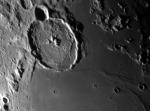 Lunar Close Up
12.02.1999
Late last month, NASA's Lunar Prospector spacecraft moved in for a closer look at the Moon. Now entering an extended mission phase, controllers have reduced the altitude of this polar lunar orbiter from 100 kilometers to about 30 kilometers (18 miles).
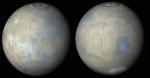 Mapping Mars
19.03.1999
This month, the Mars Global Surveyor (MGS) spacecraft began its primary mission to the red planet. Orbiting about once every two hours at an altitude of over 200 miles, instruments onboard MGS now regularly explore the Martian surface and atmosphere.
|
January February March April May June July August September October |
|||||||||||||||||||||||||||||||||||||||||||||||||