
|
You entered: Orion
 NGC 604: Giant Stellar Nursery
25.04.2024
Located some 3 million light-years away in the arms of nearby spiral galaxy M33, giant stellar nursery NGC 604 is about 1,300 light-years across. That's nearly 100 times the size of the Milky Way's Orion Nebula, the closest large star forming region to planet Earth.
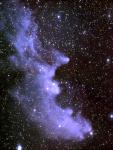 The Witch Head Nebula
27.02.2001
Double, double toil and trouble; Fire burn, and cauldron bubble -- maybe Macbeth should have consulted the Witch Head Nebula. This suggestively shaped reflection nebula is associated with the bright star Rigel in the constellation Orion.
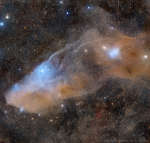 IC 4592: The Blue Horsehead Reflection Nebula
5.07.2021
Do you see the horse's head? What you are seeing is not the famous Horsehead nebula toward Orion but rather a fainter nebula that only takes on a familiar form with deeper imaging. The main part of the here imaged molecular cloud complex is a reflection nebula cataloged as IC 4592.
 APOD: 2024 November 25 Б The Horsehead Nebula
25.11.2024
One of the most identifiable nebulas in the sky, the Horsehead Nebula in Orion, is part of a large, dark, molecular cloud. Also known as Barnard 33, the unusual shape was first discovered on a photographic plate in the late 1800s.
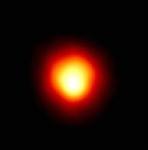 Betelgeuse, Betelgeuse, Betelgeuse
16.02.1997
Betelgeuse (sounds a lot like "beetle juice"), a red supergiant star about 600 light years distant, is seen in this Hubble Space Telescope image -- the first direct picture of the surface of a star other than the Sun. A bright, as yet unexplained hotspot is revealed on its surface!
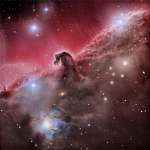 The Magnificent Horsehead Nebula
13.05.2010
Sculpted by stellar winds and radiation, a magnificent interstellar dust cloud by chance has assumed this recognizable shape. Fittingly named the Horsehead Nebula, it is some 1,500 light-years distant, embedded in the vast Orion cloud complex.
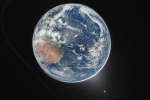 APOD: 2026 April 4 Б Hello World
4.04.2026
From pole to pole our fair planet is captured in this snapshot from space, an evocative image from a window of the Orion spacecraft Integrity. From the spacecraft's perspective the Sun is moving behind Earth's bright limb along the lower right.
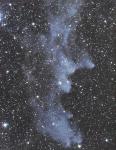 The Witch Head Nebula
29.12.2003
Double, double toil and trouble; Fire burn, and cauldron bubble -- maybe Macbeth should have consulted the Witch Head Nebula. This suggestively shaped reflection nebula is associated with the bright star Rigel in the constellation Orion.
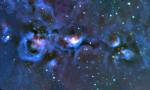 NGC 6334: The Bear Claw Nebula
6.04.1999
NGC 6334 is a cloud of gas and dust that appears to be forming massive stars. At 5500 light-years away, the Bear Claw Nebula, as it has also been dubbed, is more than three times as distant as the Orion Nebula, but still close enough for detailed study.
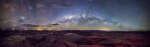 Milky Way over Moon Valley
4.12.2014
Our Milky Way Galaxy arcs over a desolate landscape in this fantastic panoramic night skyview. The otherworldly scene looks across the arid, eroded terrain of the Valle de la Luna in the Chilean Atacama desert.
|
January February March April May June July August September |
|||||||||||||||||||||||||||||||||||||||||||||||||