
|
You entered: Saturn's Moon
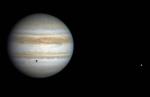 Cassini Spacecraft Approaches Jupiter
11.10.2000
A new spacecraft has entered the outer Solar System: Cassini. Launched in 1997 and bound for Saturn in 2004, Cassini sent back the above image last week while approaching the giant planet Jupiter. Cassini joins the Galileo spacecraft currently in orbit around Jupiter in studying the gas giant and its moons.
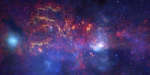 Great Observatories Explore Galactic Center
11.11.2009
Where can a telescope take you? Four hundred years ago, a telescope took Galileo to the Moon to discover craters, to Saturn to discover rings, to Jupiter to discover moons, to Venus to discover phases, and to the Sun to discover spots.
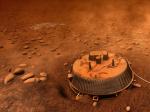 Huygens on Titan Illustrated
31.01.2006
If you could stand on Titan, what might you see? About one year ago the robotic Huygens probe landed on the enigmatic moon of Saturn and sent back the first ever images from beneath Titan's thick cloud layers.
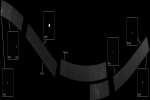 The Solar System from MESSENGER
23.02.2011
If you looked out from the center of the Solar System, what would you see? Nearly such a view was taken recently from the MESSENGER spacecraft currently orbiting the Sun from the distance of Mercury. The Sun's planets all appear as points of light, with the closest and largest planets appearing the brightest.
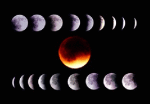 Tonight: A Total Lunar Eclipse
26.09.1996
Tonight brings the last total lunar eclipse visible from North America until the year 2000 - with the Moon becoming completely immersed in Earth's shadow. The above time-lapse photograph shows a lunar eclipse that occurred in April 1993.
 Halley Dust, Mars Dust, and Milky Way
12.05.2023
Grains of cosmic dust streaked through night skies in early May. Swept up as planet Earth plowed through the debris streams left behind by periodic Comet Halley, the annual meteor shower is known as the Eta Aquarids. This year, the Eta Aquarids peak was visually hampered by May's bright Full Moon, though.
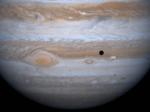 Jupiter, Io, and Shadow
26.12.2000
Just as planets orbit our Sun, Jupiter's Moons orbit Jupiter. Pictured above is the closest of Jupiter's Galilean Satellites, Io, superposed in front of the giant planet it circles. To the left of Io is a dark spot that is its own shadow.
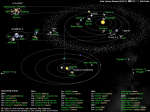 Humanity Explores the Solar System
30.04.2013
What spacecraft is humanity currently using to explore our Solar System? Presently, every inner planet has at least one robotic explorer, while several others are monitoring our Sun, some are mapping Earth's Moon, a few are chasing asteroids and comets, one is orbiting Saturn, and several are even heading out into deep space.
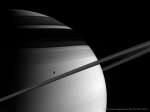 Saturn, Tethys, Rings, and Shadows
23.01.2022
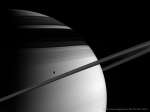
Seen from ice moon Tethys, rings and shadows would display fantastic views of the Saturnian system. Haven't dropped in on Tethys lately? Then this gorgeous ringscape from the Cassini spacecraft will have to do for now.
 Saturn, Tethys, Rings, and Shadows
5.04.2015
Seen from ice moon Tethys, rings and shadows would display fantastic views of the Saturnian system. Haven't dropped in on Tethys lately? Then this gorgeous ringscape from the Cassini spacecraft will have to do for now.
|
January February March April May June July August September October |
|||||||||||||||||||||||||||||||||||||||||||||||||