
|
You entered: Solar System
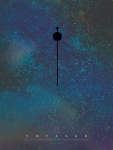 Milky Way Voyager
2.09.2017
Launched in 1977 on a tour of the outer planets of the Solar System, Voyager 1 and 2 have become the longest operating and most distant spacecraft from Earth. Nearly 16 light-hours from...
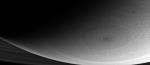 Saturn from Below
10.04.2007
Swooping below Saturn, the Cassini spacecraft spied several strange wonders. Visible in the distance are some of the many complex rings that orbit the Solar System's second largest planet. In the foreground looms the gigantic world itself, covered with white dots that are clouds high in Saturn's thick atmosphere.
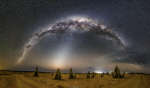 Milky Way and Zodiacal Light over Australian Pinnacles
23.10.2022
What strange world is this? Earth. In the foreground of the featured image are the Pinnacles, unusual rock spires in Nambung National Park in Western Australia. Made of ancient sea shells (limestone), how these human-sized picturesque spires formed remains a topic of research. The picturesque panorama was taken in 2017 September.
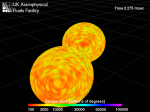 On the Origin of Gold
15.05.2005
Where did the gold in your jewelry originate? No one is completely sure. The relative average abundance in our Solar System appears higher than can be made in the early universe, in stars, and even in typical supernova explosions.
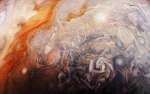 Painting with Jupiter
7.04.2018
Brush strokes of Jupiter's signature atmospheric bands and vortices form this planetary post-impressionist work of art. The creative image uses actual data from the Juno spacecraft's JunoCam. To paint on the digital canvas, a image with light and dark tones was chosen for processing and an oil-painting software filter applied.
 APOD: 2024 March 18 Б Comet Pons Brooks Swirling Coma
18.03.2024
A bright comet will be visible during next month's total solar eclipse. This very unusual coincidence occurs because Comet 12P/Pons-Brooks's return to the inner Solar System places it by chance only 25 degrees away from the Sun during Earth's April 8 total solar eclipse.
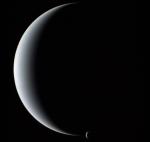 Crescent Neptune and Triton
19.06.2001
Gliding silently through the outer Solar System, the Voyager 2 spacecraft camera captured Neptune and Triton together in crescent phase in 1989. The above picture of the gas giant planet and its cloudy moon was taken from behind just after closest approach.
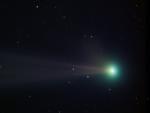 Colors of Comet Pojmanski
11.03.2006
Comet Pojmanski flew by planet Earth last weekend on a surprise trip through the inner solar system. Then an easy binocular target for morning skygazers, Pojmanski ultimately showed off a long tail, but it also presented some lovely green-blue hues as gas molecules in its tenuous coma and tail fluoresced in the sunlight.
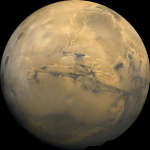 Valles Marineris: The Grand Canyon of Mars
27.03.2011
The largest canyon in the Solar System cuts a wide swath across the face of Mars. Named Valles Marineris, the grand valley extends over 3,000 kilometers long, spans as much as 600 kilometers across, and delves as much as 8 kilometers deep.
 Europa: Discover Life Under the Ice
1.04.2016
Looking for an interplanetary vacation destination? Consider a visit to Europa, one of the Solar System's most tantalizing moons. Ice-covered Europa follows an elliptical path in its 85 hour orbit around our ruling gas giant Jupiter.
|
January February March April May June July August |
||||||||||||||||||||||||||||||||||||||||||||||||||||||||