
|
You entered: cluster gas
 Star Cluster R136 Bursts Out
29.07.2012
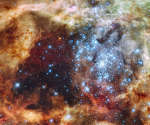
In the center of star-forming region 30 Doradus lies a huge cluster of the largest, hottest, most massive stars known. These stars, known collectively as star cluster R136, were captured above in visible light by the newly installed Wide Field Camera peering though the recently refurbished Hubble Space Telescope.
 Star Cluster R136 Bursts Out
21.12.2009
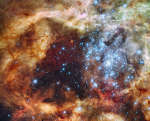
In the center of star-forming region 30 Doradus lies a huge cluster of the largest, hottest, most massive stars known. These stars, known collectively as star cluster R136, were captured above in visible light by the newly installed Wide Field Camera peering though the recently refurbished Hubble Space Telescope.
 The Heart Nebula in Hydrogen, Oxygen, and Sulfur
27.08.2017
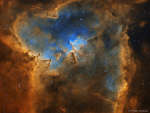
What powers the Heart Nebula? The large emission nebula dubbed IC 1805 looks, in whole, like a heart. The nebula's glow -- as well as the shape of the gas and dust clouds -- is powered by by stellar winds and radiation from massive hot stars in the nebula's newborn star cluster Melotte 15.
 From the Pleiades to the Eridanus Loop
23.03.2020
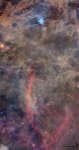
If you stare at an interesting patch of sky long enough, will it look different? In the case of Pleiades and Hyades star clusters -- and surrounding regions -- the answer is: yes, pretty different. Long...
 The Antennae
30.06.2006
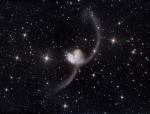
Some 60 million light-years away in the southerly constellation Corvus, two large galaxies have collided. But stars in the two galaxies - NGC 4038 and NGC 4039 - don't collide in the course of the ponderous, billion year or so long event.
 NGC4039: Starbirth and Galaxy Death
6.05.1997
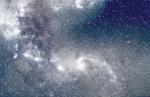
Do star clusters form when galaxies collide? Quite possibly, according to Hubble Space Telescope observations of the "Antennae", two galaxies thought to be in the early stages of a collision.
 The W4 Chimney
7.02.2000
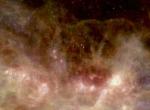
A huge chimney venting hot clouds of gas out from the plane of our Milky Way Galaxy has recently been imaged in radio waves. The Canadian Galactic Plane Survey team used an array of radio telescopes to survey an ionized gas region known as W4.
 Facing NGC 6946
26.07.2024
From our vantage point in the Milky Way Galaxy, we see NGC 6946 face-on. The big, beautiful spiral galaxy is located just 20 million light-years away, behind a veil of foreground dust and stars in the high and far-off constellation Cepheus.
 Clouds of Perseus
21.10.2011
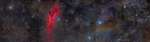
Cosmic clouds of gas and dust drift across this magnificent panorama, spanning some 17 degrees near the southern boundary of the heroic constellation Perseus. The collaborative skyscape begins with bluish stars of Perseus at the left, but the eye is drawn to the striking, red NGC 1499.
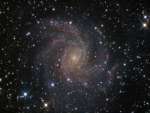 Facing NGC 6946
15.08.2008
From our vantage point in the Milky Way Galaxy, we see NGC 6946 face-on. The big, beautiful spiral galaxy is located just 10 million light-years away, behind a veil of foreground dust and stars in the high and far-off constellation of Cepheus.
|
January February March April May June July August |
||||||||||||||||||||||||||||||||||||||||||||||||||||||||