
|
You entered: emission
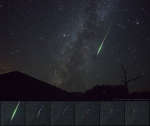 Perseid Fireball at Sunset Crater
19.08.2016
On the night of August 12, this bright Perseid meteor flashed above volcanic Sunset Crater National Monument, Arizona, USA, planet Earth. Streaking along the summer Milky Way, its initial color is likely due to the shower meteor's characteristically high speed.
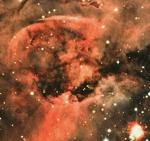 In the Center of the Keyhole Nebula
21.07.1997
Stars, like people, do not always go gentle into that good night. The above Keyhole Nebula results from dying star Eta Carinae's violently casting off dust and gas during its final centuries. Eta Carinae is many times more massive than our own Sun, and should eventually undergo a tremendous supernova explosion.
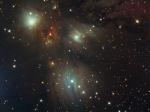 Still Life with NGC 2170
3.03.2005
In this beautiful celestial still life composed with a cosmic brush, dusty nebula NGC 2170 shines at the upper left. Reflecting the light of nearby hot stars, NGC 2170 is joined by other bluish reflection nebulae and a compact red emission region against a backdrop of stars.
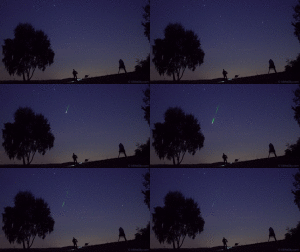 Real Time Perseid
8.09.2018
Bright meteors and dark night skies made this year's Perseid meteor shower a great time for a weekend campout. And while packing away their equipment, skygazers at a campsite in the mountains...
 Elements of the Swan Nebula
11.08.2003
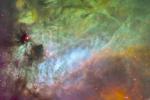
In the depths of the dark clouds of dust and molecular gas known as M17, stars continue to form. Also known as the Omega Nebula and Horseshoe Nebula, the darkness of M17's molecular clouds results from background starlight being absorbed by thick filaments of carbon-based smoke-sized dust.
 The Deep Lagoon
29.07.2015
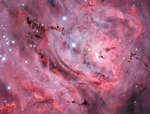
Ridges of glowing interstellar gas and dark dust clouds inhabit the turbulent, cosmic depths of the Lagoon Nebula. Also known as M8, The bright star forming region is about 5,000 light-years distant.
 Planet Aurora
13.05.2017
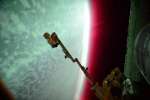
What bizarre alien planet is this? It's planet Earth of course, seen from the International Space Station through the shimmering glow of aurorae. About 400 kilometers (250 miles) above Earth, the orbiting station is itself within the upper realm of the auroral displays.
 M78 Wide Field
21.01.2021
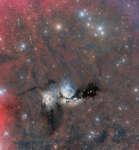
Interstellar dust clouds and glowing nebulae abound in the fertile constellation of Orion. One of the brightest, M78, is centered in this colorful, wide field view, covering an area north of Orion's belt. At a distance of about 1,500 light-years, the bluish reflection nebula is around 5 light-years across.
 NGC 2244: A Star Cluster in the Rosette Nebula
17.03.2002
In the heart of the Rosette Nebula lies a bright open cluster of stars that lights up the nebula. The stars of NGC 2244 formed from the surrounding gas only four million years ago and emit light and wind that define the nebula's appearance today.
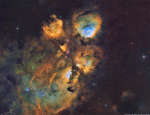 NGC 6334: The Cats Paw Nebula
10.05.2022
Nebulas are perhaps as famous for being identified with familiar shapes as perhaps cats are for getting into trouble. Still, no known cat could have created the vast Cat's Paw Nebula visible toward the constellation of the Scorpion (Scorpius.
|
January February March April May June July August September |
|||||||||||||||||||||||||||||||||||||||||||||||||