
|
You entered: space station
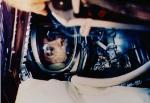 Alan B. Shepard Jr. 1923 1998
24.07.1998
On another Friday (May 5, 1961), at the dawn of the space age, NASA controllers "lit the candle" and sent Alan B. Shepard Jr. arcing into space atop a Redstone rocket. The picture shows...
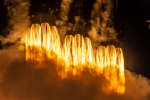 Falcon Heavy Launch Close up
19.04.2019
Twenty seven Merlin rocket engines are firing in this close-up of the launch of a Falcon Heavy rocket. Derived from three Falcon 9 first stage rockets with nine Merlin rocket engines each, the Falcon Heavy left NASA's Kennedy Space Center launch pad 39A on April 11.
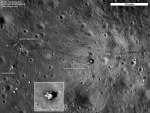 Apollo 17 Site: A Sharper View
8.09.2011
This view of the Apollo 17 landing site in the Taurus-Littrow valley was captured last month by the Lunar Reconnaissance Orbiter (LRO), the sharpest ever recorded from space. The high resolution image data...
 APOD: 2024 February 20 Б AM1054: Stars Form as Galaxies Collide
19.02.2024
When galaxies collide, how many stars are born? For AM1054-325, featured here in a recently released image by the Hubble Space Telescope, the answer is millions. Instead of stars being destroyed as galaxy AM1054-325 and a nearby galaxy circle each other, their gravity and motion has ignited stellar creation.
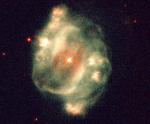 NGC 5307: A Symmetric Planetary Nebula
30.12.1997
Some stellar nebulae are strangely symmetric. For example, every major blob of gas visible on the upper left of NGC 5307 appears to have a counterpart on the lower right. This picture taken by the Hubble Space Telescope was released last week. NGC 5307 is an example of a planetary nebula with a spiral shape.
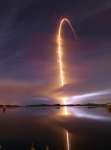 RBSP Night Launch
2.09.2012
This graceful arc traces a Delta rocket climbing through Thursday's early morning skies over Cape Canaveral Air Force Station in Florida, USA. Snug inside the rocket's Centaur upper stage were NASA's twin Radiation Belt Storm Probes (RBSP), now in separate orbits within planet Earth's Van Allen radiation belts.
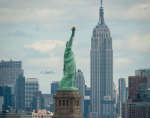 Shuttle Enterprise Over New York
9.05.2012
What's that in the background? Two famous New York City icons stand tall in the above photo taken last week. On the left looms the Statue of Liberty, a universal symbol of freedom, while on the right rises the Empire State Building, now the second largest building in the city.
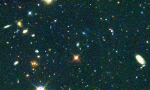 Watch Galaxies Form
5.09.1996
Snips and snails and puppy dog tails, is that what galaxies were made of? In a report released yesterday and soon to be published in Nature, astronomers have imaged an interesting distant patch of sky with the orbiting Hubble Space Telescope.
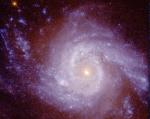 Spiral Galaxy NGC 3310 in Ultraviolet
16.01.2001
Why is NGC 3310 bursting with young stars? The brightest of these new stars are so hot that they light up this spiral galaxy not only in blue light, but in light so blue humans can't see it: ultraviolet. The Hubble Space Telescope took the above photograph in different bands of ultraviolet light.
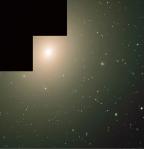 Young Star Clusters in an Old Galaxy
4.07.2002
Elliptical galaxy NGC 4365 is old, probably about 12 billion years old. Like most elliptical galaxies, this galaxy was thought to be full of old stars too, its burst of star forming activity having long since ended.
|
January February March April May June July August September October |
|||||||||||||||||||||||||||||||||||||||||||||||||