
|
You entered: spiral galaxy
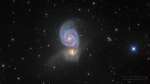 M51: The Whirlpool Galaxy
18.10.2017
Find the Big Dipper and follow the handle away from the dipper's bowl until you get to the last bright star. Then, just slide your telescope a little south and west and you'll come upon this stunning pair of interacting galaxies, the 51st entry in Charles Messier's famous catalog.
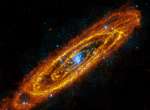 The Once and Future Stars of Andromeda
19.01.2011
The big, beautiful Andromeda Galaxy, aka M31, is a spiral galaxy a mere 2.5 million light-years away. Two space-based observatories have combined to produce this intriguing composite image of Andromeda, at wavelengths outside the visible spectrum. The remarkable view follows the locations of this galaxy's once and future stars.
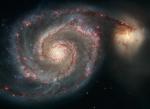 M51: Cosmic Whirlpool
10.11.2006
Follow the handle of the Big Dipper away from the dipper's bowl, until you get to the handle's last bright star. Then, just slide your telescope a little south and west and you might find this stunning pair of interacting galaxies, the 51st entry in Charles Messier's famous catalog.
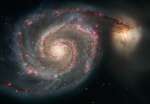 M51: Cosmic Whirlpool
4.01.2008
Follow the handle of the Big Dipper away from the dipper's bowl, until you get to the handle's last bright star. Then, just slide your telescope a little south and west and you might find this stunning pair of interacting galaxies, the 51st entry in Charles Messier's famous catalog.
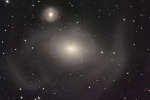 NGC 1316: After Galaxies Collide
2.09.2008
Astronomers turn detectives when trying to figure out the cause of startling sights like NGC 1316. Their investigation indicates that NGC 1316 is an enormous elliptical galaxy that started, about 100 million years ago, to devour a smaller spiral galaxy neighbor, NGC 1317, just above it.
 M51: Cosmic Whirlpool
28.04.2005
Follow the handle of the Big Dipper away from the dipper's bowl, until you get to the handle's last bright star. Then, just slide your telescope a little south and west and you might find this stunning pair of interacting galaxies, the 51st entry in Charles Messier's famous catalog.
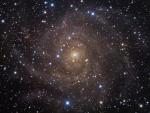 Hidden Galaxy IC 342
5.10.2006
Similar in size to other large, bright spiral galaxies IC 342 is a mere 7 million light-years distant in the long-necked, northern constellation Camelopardalis. A sprawling island universe, IC 342 would otherwise...
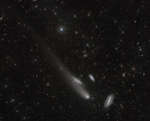 Three Galaxies and a Comet
20.12.2023
Distant galaxies abound in this one degree wide field of view toward the southern constellation Grus (The Crane). But the three spiral galaxies at the lower right are quite striking. In fact, all three galaxies are grouped about 70 million light years away and sometimes known as the Grus Triplet.
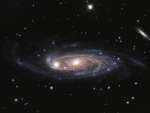 Rubin s Galaxy
24.01.2020
In this Hubble Space Telescope image the bright, spiky stars lie in the foreground toward the heroic northern constellation Perseus and well within our own Milky Way galaxy. In sharp focus beyond is UGC 2885, a giant spiral galaxy about 232 million light-years distant.
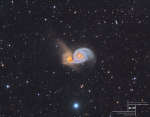 The Whirlpool Galaxy and Beyond
5.09.2016
Follow the handle of the Big Dipper away from the dipper's bowl, until you get to the handle's last bright star. Then, just slide your telescope a little south and west and you might find this stunning pair of interacting galaxies, the 51st entry in Charles Messier's famous catalog.
|
January February March April May June July August September October |
|||||||||||||||||||||||||||||||||||||||||||||||||