
|
You entered: time
4.10.2025
No one on Earth sees the Moon rotate like this. That's because the Moon is tidally locked in synchronous rotation, showing only one side to denizens of our fair planet. Still, given modern...
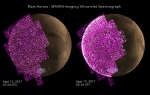 Global Aurora at Mars
6.10.2017
A strong solar event last month triggered intense global aurora at Mars. Before (left) and during (right) the solar storm, these projections show the sudden increase in ultraviolet emission from martian aurora, more than 25 times brighter than auroral emission previously detected by the orbiting MAVEN spacecraft.
 Meteor Fireballs in Light and Sound
15.03.2021
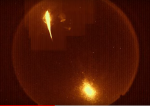
Yes, but have you ever heard a meteor? Usually, meteors are too far away to make any audible sound. However, a meteor will briefly create an ionization trail that can reflect a distant radio signal. If the geometry is right, you may momentarily hear -- through your radio -- a distant radio station even over static.
 APOD: 2025 August 8 Б Dawn of the Crab
8.08.2025
One of the all-time historic skyscapes occured in July 1054, when the Crab Supernova blazed into the dawn sky. Chinese court astrologers first saw the Guest Star on the morning of 4 July 1054 next to the star Tianguan (now cataloged as Zeta Tauri).
 A Landing On Mars
4.07.1997
Today, July 4th, at about 10:00 AM Pacific Daylight Time (PDT), the Mars Pathfinder spacecraft will land on Mars. Ninety minutes before reaching the surface Pathfinder will begin a flurry of activity.
 November s Lunar Eclipse
7.11.2003
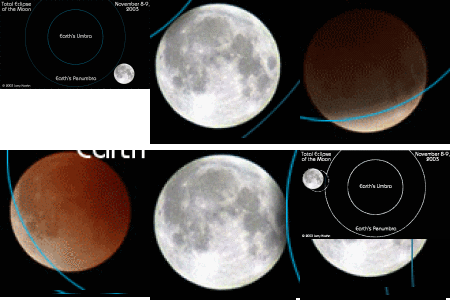
The Moon slides through the Earth's shadow this Saturday night / Sunday morning (November 8/9) giving skygazers in the Americas, Europe, Africa, and western Asia a chance to enjoy a total lunar eclipse. As lunar eclipses go, this will be a brief one though, with the total phase lasting only about 25 minutes.
 The Bubble Nebula
2.09.2010
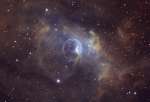
Blown by the wind from a massive star, this interstellar apparition has a surprisingly familiar shape. Cataloged as NGC 7635, it is also known simply as The Bubble Nebula. Although it looks delicate, the 10 light-year diameter bubble offers evidence of violent processes at work.
 A Tale of Two Nebulae
16.05.2003
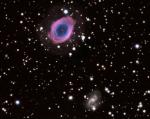
This colorful telescopic view towards the northern constellation Lyra reveals dim outer regions around M57, popularly known as the Ring Nebula. While modern astronomers still refer to M57 as a planetary nebula, at one light-year across M57 is not a planet but the gaseous shroud of a dying sun-like star.
 Solar System Portrait
11.02.2017
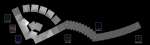
On Valentine's Day in 1990, cruising four billion miles from the Sun, the Voyager 1 spacecraft looked back one last time to make this first ever Solar System family portrait. The complete portrait is a 60 frame mosaic made from a vantage point 32 degrees above the ecliptic plane.
 Solar System Family Portrait
14.02.2019
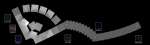
On Valentine's Day in 1990, cruising four billion miles from the Sun, the Voyager 1 spacecraft looked back one last time to make this first ever Solar System family portrait. The complete portrait is a 60 frame mosaic made from a vantage point 32 degrees above the ecliptic plane.
|
January February March April May June July August September |
|||||||||||||||||||||||||||||||||||||||||||||||||