
|
You entered: comet tail
 Five Bright Comets from SOHO
10.10.2024
Five bright comets are compared in these panels, recorded by a coronograph on board the long-lived, sun-staring SOHO spacecraft. Arranged chronologically all are recognizable by their tails streaming away from...
 Comet ISON Before and After
29.11.2013
Sungrazing Comet ISON reached perihelion, its closest approach to the Sun, yesterday, November 28, at 18:45 UT. The comet passed just over 1 million kilometers above the solar surface, a distance less than the diameter of the Sun.
 Comet C/2025 F2 SWAN
18.04.2025
In late March, the comet now designated C/2025 F2 SWAN was found independently by citizen scientists Vladimir Bezugly, Michael Mattiazzo, and Rob Matson while examining publicly available image data from the Solar Wind ANisotropies (SWAN) camera on the sun-staring SOHO spacecraft.
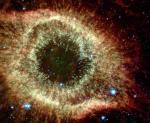 Infrared Helix
12.01.2006
Over six hundred light years from Earth, in the constellation Aquarius, a sun-like star is dying. Its last few thousand years have produced the Helix Nebula (NGC 7293), a well studied and nearby example of a Planetary Nebula, typical of this final phase of stellar evolution.
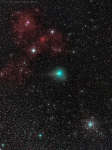 A Charioteer s Comet
1.03.2019
Still racing across planet Earth's night skies, Comet Iwamoto (C/2018 Y1) shares this pretty telescopic field of view with stars and nebulae of northern constellation Auriga, the Charioteer. Captured on February 27, Iwamoto's greenish coma and faint tail appear between a complex of reddish emission nebulae and open star cluster M36 (bottom right).
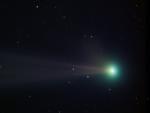 Colors of Comet Pojmanski
11.03.2006
Comet Pojmanski flew by planet Earth last weekend on a surprise trip through the inner solar system. Then an easy binocular target for morning skygazers, Pojmanski ultimately showed off a long tail, but it also presented some lovely green-blue hues as gas molecules in its tenuous coma and tail fluoresced in the sunlight.
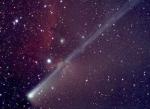 Comet SOHO and Nebulae in Orion
4.06.1998
Astrophotographer Michael Horn captured this gorgeous view of comet SOHO in the dark night sky above Wandibindle, Queensland, Australia on May 23rd. On this date, comet SOHO was moving against the background of the nebula-rich constellation of Orion.
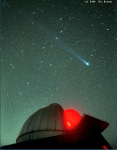 Hyakutake, Big Dipper, and Observatory Dome
1.04.1996
In one of the more spectacular pictures yet taken, Comet Hyakutake is shown here on March 26 high in the dark Missouri sky. In the foreground is Elmcrest Observatory complete with a dim red light glowing inside the dome.
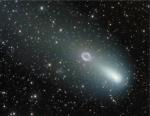 Comet Meets Ring Nebula: Part II
12.05.2006
Moving rapidly through planet Earth's night sky, Fragment C of crumbling comet 73P/Schwassmann-Wachmann 3 passed almost directly in front of M57 - the Ring Nebula, and faint spiral galaxy IC 1296 on May 8.
 The Colors of Comet Hyakutake
29.03.1996
The colors of Comet Hyakutake are caused by the action of sunlight on the dust and gas produced by the warming nucleus. The microscopic dust particles reflect sunlight while the sun's ultraviolet radiation excites and ionizes the gas molecules causing them to glow or fluoresce in a range of visible colors.
|
January February March April May June July August September |
|||||||||||||||||||||||||||||||||||||||||||||||||