
|
You entered: constellation
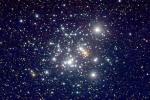 NGC 4755: A Jewel Box of Stars
18.06.2001
The great variety of star colors in this open cluster underlie its name: The Jewel Box. One of the bright central stars is a red supergiant, in contrast to the many blue stars that surround it. The cluster, also known as Kappa Crucis contains just over 100 stars, and is about 10 million years old.
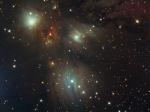 Still Life with NGC 2170
3.03.2005
In this beautiful celestial still life composed with a cosmic brush, dusty nebula NGC 2170 shines at the upper left. Reflecting the light of nearby hot stars, NGC 2170 is joined by other bluish reflection nebulae and a compact red emission region against a backdrop of stars.
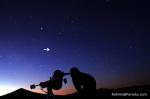 Nova Over Iran
19.02.2007
A bright new nova is being studied by astronomers. The officially dubbed Nova Scorpii 2007 has become so bright in recent days that it is now visible to the unaided eye. Adventurous early morning sky enthusiasts should look in dark skies toward the constellation of the Scorpion, just below Jupiter and Antares.
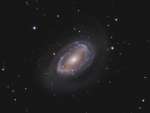 One Armed Spiral Galaxy NGC 4725
6.06.2009
While most spiral galaxies, including our own Milky Way, have two or more spiral arms, NGC 4725 seems to have only one. In this sharp color image, the solo spira mirabilis is tightly wound, traced by bluish, newborn star clusters.
 Globular Star Cluster 47 Tuc
16.01.2011
Globular star cluster 47 Tucanae is a jewel of the southern sky. Also known as NGC 104, it roams the halo of our Milky Way Galaxy along with some 200 other globular star clusters.
 Orion and Aurora over Iceland
24.03.2014
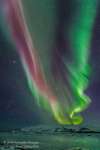
If you see a sky like this -- photograph it. A month ago in Iceland, an adventurous photographer (pictured) chanced across a sky full of aurora and did just that. In the foreground lies the stratovolcano жrФfajЖkull. In the background, among other sky delights, lies the constellation of Orion, visible to the aurora's left.
 The Great Nebula in Carina
7.05.2019
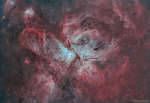
What's happening in the center of the Carina Nebula? Stars are forming, dying, and leaving an impressive tapestry of dark dusty filaments. The entire Carina Nebula, cataloged as NGC 3372, spans over 300 light years and lies about 8,500 light-years away in the constellation of Carina.
 Galaxies in Pegasus
15.10.2020
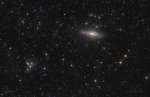
This sharp telescopic view reveals galaxies scattered beyond the stars of the Milky Way, at the northern boundary of the high-flying constellation Pegasus. Prominent at the upper right is NGC 7331. A mere...
 A Giant Starspot on HD 12545
12.07.2000
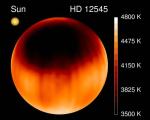
What could cause a star to have such a large spot? Our Sun itself frequently has sunspots, relatively cool dark magnetic depressions that move across its surface. HD 12545, however, exhibits the largest starspots yet observed.
 The Snake Nebula from CFHT
9.04.2002
What slithers overhead? The dark winding lanes visible in part of the constellation of Ophiuchus belong to the Snake Nebula. Also known as Barnard 72, the Snake Nebula is a series of dark absorption clouds made up of molecular gas and interstellar dust.
|
January February March April May June July August September October |
|||||||||||||||||||||||||||||||||||||||||||||||||