
|
You entered: full moon
 The Elephant s Trunk in Cepheus
20.11.2024
Like an illustration in a galactic Just So Story, the Elephant's Trunk Nebula winds through the emission region and young star cluster complex IC 1396, in the high and far off constellation of Cepheus. Also known as vdB 142, this cosmic elephant's trunk is over 20 light-years long.
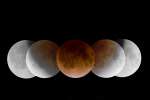 The Umbra of Earth
15.12.2011
The dark, inner shadow of planet Earth is called the umbra. Shaped like a cone extending into space, it has a circular cross section most easily seen during a lunar eclipse. For example, last Saturday the Full Moon slid across the southern half of Earth's umbral shadow, entertaining moonwatchers around much of the planet.
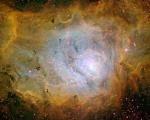 The Lagoon Nebula in Three Colors
20.08.2001
The bright Lagoon Nebula is home to a diverse array of astronomical objects. Particularly interesting sources include a bright open cluster of stars and several energetic star-forming regions. When viewed by eye, cluster light...
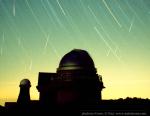 Leonids Over Korean Observatory
11.12.2001
There were two peaks to this year's Leonid Meteor Shower. The first peak was best seen during the early morning hours of November 18 in North America, while the second peak, almost twice the intensity of the first, occurred eight hours later and was best seen from Asia.
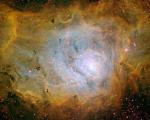 The Lagoon Nebula in Three Colors
6.10.2002
The bright Lagoon Nebula is home to a diverse array of astronomical objects. Particularly interesting sources include a bright open cluster of stars and several energetic star-forming regions. When viewed by eye, cluster light...
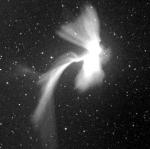 A Leonid Meteor Explodes
22.11.1998
Click on the above image and watch a Leonid meteor explode. The tremendous heat generated by the collision of a small sand-bit moving at 70 kilometers/second with the Earth's upper atmosphere causes the rock-fragment to heat up, glow brightly, and disintegrate.
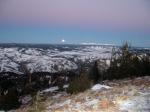 Shadow Set
3.02.2006
A nearly full Moon and planet Earth's shadow set together in this scene captured on January 13th from snowy Mt. Jelm, home of the Wyoming Infrared Observatory. For early morning risers (and late...
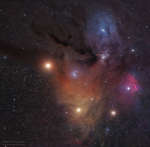 Mars in the Clouds
7.09.2016
Wandering through this stunning field of view, Mars really is in front of these colorful cosmic clouds. The mosaic contructed from telescopic images is about 5 degrees (10 full moons) across. It captures...
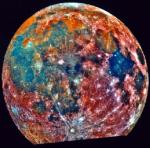 The Colorful Moon
6.01.1998
Do you recognize the Earth's Moon when you see it? The crazy, patchwork appearance of this false color image makes this nearly full view of our Moon's familiar nearside look very strange. The image was taken in 1992 by the Galileo spacecraft enroute to Jupiter.
 A Galilean Night
23.10.2009
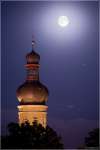
Driving along on a summer evening, near the small town of Weikersheim in southern Germany, photographer Jens Hackmann had to stop. He couldn't resist pointing his camera and telephoto lens at this lovely conjunction of a Full Moon and planet Jupiter looming near the steeple of a local church.
|
January February March April May June July August September October |
|||||||||||||||||||||||||||||||||||||||||||||||||