
|
You entered: star system
 The Day After Mars
1.11.2019
October 31, 1938 was the day after Martians encountered planet Earth, and everything was calm. Reports of the invasion were revealed to be part of a Halloween radio drama, the now famous broadcast based on H.G. Wells' scifi novel War of the Worlds.
 The Orion Bullets
3.03.2019
Why are bullets of gas shooting out of the Orion Nebula? Nobody is yet sure. First discovered in 1983, each bullet is actually about the size of our Solar System, and moving at about 400 km/sec from a central source dubbed IRc2.
 The Hubble SWEEPS Field
13.10.2006
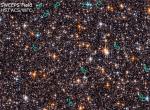
This crowded star field towards the center of our Milky Way Galaxy turns out to be a great place to search for planets beyond our solar system. In fact, repeatedly imaging about...
 Fragments of Comet LINEAR
11.08.2000
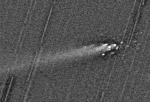
What do you call a bunch of comet fragments anyway ... a flock, a covey, a swarm? The question is definitely relevant to comet LINEAR (C/1999 S4 LINEAR) whose nucleus apparently fragmented late last month during its first trip through the inner solar system.
 Blue Comet Meets Blue Stars
12.02.2018
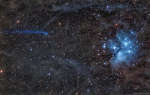
What's that heading for the Pleiades star cluster? It appears to be Comet C/2016 R2 (PanSTARRS), but here, appearances are deceiving. On the right and far in the background, the famous Pleiades star cluster is dominated by blue light from massive young stars.
 In the Center of the Omega Nebula
8.02.2004
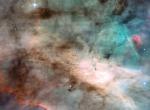
In the depths of the dark clouds of dust and molecular gas known as the Omega Nebula, stars continue to form. The above image from the Hubble Space Telescope's Advanced Camera for Surveys shows exquisite detail in the famous star-forming region.
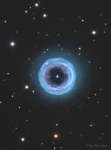 APOD: 2026 March 4 Б Shapley 1: An Annular Planetary Nebula
4.03.2026
WhatБs looking back at you isnБt a cosmic eye, but Shapley 1, a beautifully symmetric planetary nebula. Shapley 1, also known as the Fine Ring Nebula or PLN 329+2.1, bejewels the southern sky constellation of the Carpenter's Square (Norma).
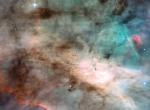 In the Center of the Omega Nebula
1.05.2002
In the depths of the dark clouds of dust and molecular gas known as the Omega Nebula, stars continue to form. The above image from the Hubble Space Telescope's newly installed Advanced Camera for Surveys shows unprecedented detail in the famous star-forming region.
 In the Center of the Omega Nebula
6.05.2012
In the depths of the dark clouds of dust and molecular gas known as the Omega Nebula, stars continue to form. The above image from the Hubble Space Telescope's Advanced Camera for Surveys shows exquisite detail in the famous star-forming region.
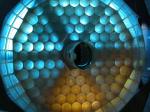 SOFIA s Mirror
22.10.2004
The candy-dish appearance of this high-tech astronomical mirror is striking. Made of a special glass ceramic material called Zerodur, it actually measures 2.7 meters across. The transparent surface has not yet received a reflective...
|
January February March April May June July August September October |
|||||||||||||||||||||||||||||||||||||||||||||||||