
|
You entered: surface
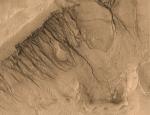 Unusual Gullies and Channels on Mars
5.02.2003
What could have formed these unusual channels? Inside Newton Basin on Mars, numerous narrow channels run from the top down to the floor. The above picture covers a region spanning about 1500 meters across.
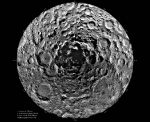 Ice at the Lunar South Pole
4.12.1996
Ice on the Moon? The prospecting Clementine spacecraft may well have discovered it. In 1994, Clementine spent 70 days in lunar orbit mapping the Moon's surface. Shown above is a dramatically detailed composite view centered on the Lunar South Pole - constructed from 1500 Clementine images.
 A Martian Day's End
6.07.1997
A Day or "Sol" on Mars is only 40 minutes longer than an Earth day - and Pathfinder's first day on Mars, Sol 1 according to its local calendar, was an eventful one. Still...
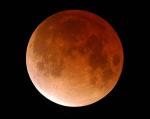 Sunset Moonlight
21.11.2003
November's lunar eclipse was one of the shortest in recent years and also one of the brightest -- demonstrating that the Earth's shadow is not completely dark. The eclipsed Moon remained easily visible...
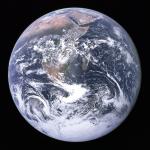 Welcome to Planet Earth
25.03.2007
Welcome to Planet Earth, the third planet from a star named the Sun. The Earth is shaped like a sphere and composed mostly of rock. Over 70 percent of the Earth's surface is water. The planet has a relatively thin atmosphere composed mostly of nitrogen and oxygen.
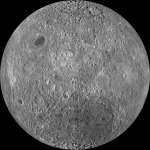 Lunar Farside
9.04.2011
Tidally locked in synchronous rotation, the Moon always presents its familiar nearside to denizens of planet Earth. From lunar orbit, the Moon's farside can become familiar, though. In fact this sharp picture, a mosaic from the Lunar Reconnaissance Orbiter's wide angle camera, is centered on the lunar farside.
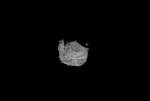 Rosetta Approaches Comet Churyumov Gerasimenko
11.08.2014
What does it look like to approach a comet? Early this month humanity received a new rendition as the robotic Rosetta spacecraft went right up to -- and began orbiting -- the nucleus of Comet 67P/Churyumov-Gerasimenko.
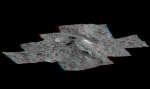 3D Ahuna Mons
19.03.2016
Get out your red/blue glasses and gaze across Ceres at mysterious mountain Ahuna Mons. Shown in a 3D anaglyph perspective view, the mosaicked image data was captured in December of 2015, taken from the Dawn spacecraft's low-altitude mapping orbit about 385 kilometers above the surface of the dwarf planet.
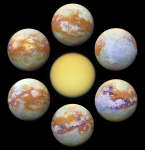 Seeing Titan
20.08.2020
Shrouded in a thick atmosphere, Saturn's largest moon Titan really is hard to see. Small particles suspended in the upper atmosphere cause an almost impenetrable haze, strongly scattering light at visible wavelengths and hiding Titan's surface features from prying eyes.
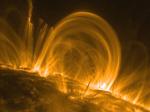 Heating Coronal Loops
14.08.2005
Why is the corona of the Sun so hot? Extending above the photosphere or visible surface of the Sun, the faint, tenuous solar corona can't be easily seen from Earth, but it is measured to be hundreds of times hotter than the photosphere itself.
|
January February March April May June July August September October |
|||||||||||||||||||||||||||||||||||||||||||||||||