
|
You entered: image
 Quadrantids of the North
10.01.2024
Named for a forgotten constellation, the Quadrantid Meteor Shower puts on an annual show for planet Earth's northern hemisphere skygazers. The shower's radiant on the sky lies within the old, astronomically obsolete constellation Quadrans Muralis.
 APOD: 2025 April 7 Б NGC 4414: A Flocculent Spiral Galaxy
6.04.2025
How much mass do flocculent spirals hide? The featured image of flocculent spiral galaxy NGC 4414 was taken with the Hubble Space Telescope to help answer this question. Flocculent spirals -- galaxies without well-defined spiral arms -- are a quite common form of galaxy, and NGC 4414 is one of the closest.
 Solar Eclipse
11.06.2025
On April 20, 2023 the shadow of a New Moon raced across planet Earth's southern hemisphere. When viewed along a narrow path that mostly avoided landfall, the Moon in silhouette created a hybrid solar eclipse.
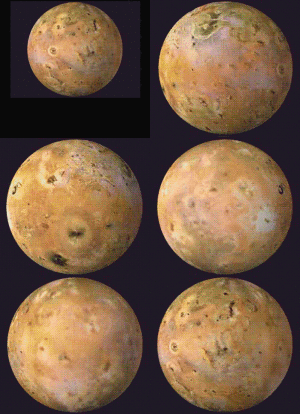 Io Rotating
24.10.2000
The surface of Io is continually changing. Jupiter's moon is the home to many powerful volcanoes so active they are effectively turning the moon inside out. The above time-lapse sequence is a composite of images taken during two space missions that approached the violent moon: Voyager and Galileo.
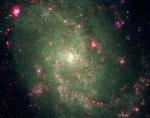 Elements of Nearby Spiral M33
27.09.2001
Spiral galaxy M33 is a mid-sized member of our Local Group of Galaxies. M33 is also called the Triangulum Galaxy for the constellation in which it resides. About four times smaller (in radius) than...
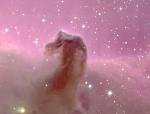 The Horsehead Nebula
15.12.2001
One of the most identifiable nebulae in the sky, the Horsehead Nebula in Orion, is part of a large, dark, molecular cloud. Also known as Barnard 33, the unusual shape was first discovered on a photographic plate in the late 1800s.
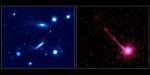 PKS 1127 145: Quasar View
7.02.2002
The quasar known as PKS 1127-145 lies ten billion light-years from our fair planet. A Hubble Space Telescope view in the left panel shows this quasar along with other galaxies as they appear in optical light. The quasar itself is the brightest object in the lower right corner.
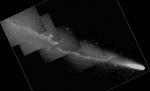 Comet Ikeya-Zhangs Busy Tail
17.03.2002
One of the brightest comets of the past five years will likely reach its peak brightness this week. Comet Ikeya-Zhang, officially known as C/2002 C1, can now be seen without aide from a dark location above the western horizon shortly after sunset.
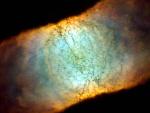 IC 4406: A Seemingly Square Nebula
18.06.2002
How can a round star make a square nebula? This conundrum comes to light when studying planetary nebulae like IC 4406. Evidence indicates that IC 4406 is likely a hollow cylinder, with its square appearance the result of our vantage point in viewing the cylinder from the side.
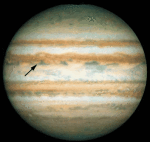 24 Hours from Jupiter
5.12.1995
NASA's robot spacecraft Galileo began its long voyage to Jupiter more than six years and 2.3 billion miles ago. About 24 hours from now it will reach its destination. On arrival (December...
|
January February March April May June July August September |
|||||||||||||||||||||||||||||||||||||||||||||||||