
|
You entered: Milky Way
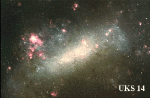 The Large Cloud Of Magellan (LMC)
24.01.1998
Ferdinand Magellan and his crew had plenty of time to study the southern sky during their famous voyage around the world. As a result, two fuzzy cloud-like objects, not visible to northern hemisphere dwellers, are now known as the Clouds of Magellan.
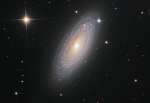 Spiral Galaxy NGC 2841
29.03.2008
Some 50 million light-years distant, spiral galaxy NGC 2841 can be found in the northern constellation of Ursa Major. This sharp view of the gorgeous island universe shows off a striking yellow nucleus and galactic disk with tightly wound spiral arms.
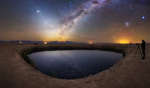 Laguna Starry Sky
27.01.2018
Staring toward the heavens, one of the many lagunas in the Atacama Desert salt flat calmly reflects a starry night sky near San Pedro de Atacama, Chile, planet Earth. Cosmic rifts of dust, star clouds, and nebulae of the central Milky Way galaxy are rising in the east, beyond a volcanic horizon.
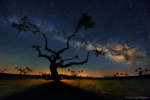 The Galaxy Tree
30.12.2018
First came the trees. In the town of Salamanca, Spain, the photographer noticed how distinctive a grove of oak trees looked after being pruned. Next came the galaxy. The photographer stayed up until 2 am, waiting until the Milky Way Galaxy rose above the level of a majestic looking oak.
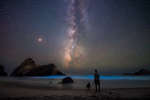 On the Beach with Mars
8.06.2019
At the end of last year's northern summer, after its dazzling opposition, Mars still shone brightly in the night. The celestial beacon easily attracted the attention of these two night skygazers who stood...
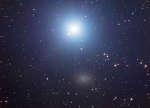 Bright Star Regulus near the Leo I Dwarf Galaxy
10.01.2012
The star near the top is so bright that it is sometimes hard to notice the galaxy toward the bottom. Pictured above, both the star, Regulus, and the galaxy, Leo I, can be found within one degree of each other toward the constellation of the Lion (Leo).
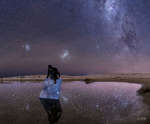 Night Sky Reflected
13.09.2021
What's that in the mirror? In the featured image of the dark southern sky, the three brightest galaxies of the night are all relatively easy to identify. Starting from the left, these are the Small Magellanic Cloud (SMC), the Large Magellanic Cloud (LMC), and part of the central band of our Milky Way Galaxy.
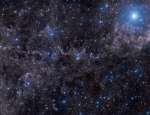 Stars in a Dusty Sky
28.09.2012
Bright star Markab anchors this dusty skyscape. At the top right corner of the frame, Markab itself marks a corner of an asterism known as the Great Square, found within the boundaries of the constellation Pegasus, the flying horse.
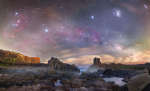 From Orion to the Southern Cross
18.01.2022
This is a sky filled with glowing icons. On the far left is the familiar constellation of Orion, divided by its iconic three-aligned belt stars and featuring the famous Orion Nebula, both partly encircled by Barnard's Loop. Just left of center in the featured image is the brightest star in the night: Sirius.
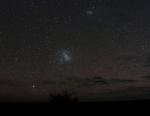 Magellanic Morning
9.08.2006
This early morning skyscape recorded near Winton, Queensland, Australia, looks toward the southeast. Low clouds are seen in silhouette against the first hints of sunlight, while two famous cosmic clouds, the Clouds of Magellan, also hover in the brightening sky.
|
January February March April May June July August September October |
|||||||||||||||||||||||||||||||||||||||||||||||||