
|
You entered: dark nebula
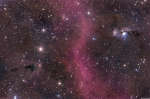 Decorating the Sky
11.12.2019
Bright stars, clouds of dust and glowing nebulae decorate this cosmic scene, a skyscape just north of Orion's belt. Close to the plane of our Milky Way galaxy, the wide field view spans about 5.5 degrees. Striking bluish M78, a reflection nebula, is on the right.
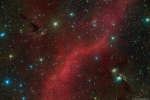 North of Orion s Belt
4.11.2020
Bright stars, interstellar clouds of dust and glowing nebulae fill this cosmic scene, a skyscape just north of Orion's belt. Close to the plane of our Milky Way Galaxy, the wide field view spans just under 5 degrees or about 10 full moons on the sky.
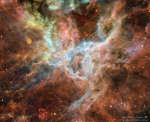 In the Heart of the Tarantula Nebula
19.05.2018
In the heart of monstrous Tarantula Nebula lies huge bubbles of energetic gas, long filaments of dark dust, and unusually massive stars. In the center of this heart, is a knot of stars so dense that it was once thought to be a single star.
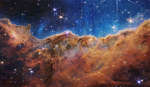 Carina Cliffs from the Webb Space Telescope
4.09.2022
Stars created these cliffs. Specifically, the destructive winds and energetic light from the stars in the open cluster NGC 3324 eroded away part of a mountain of dark interstellar dust in the northern part of the Carina Nebula.
 APOD: 2023 September 26 Б IC 4592: The Blue Horsehead Reflection Nebula
25.09.2023
Do you see the horse's head? What you are seeing is not the famous Horsehead nebula toward Orion, but rather a fainter nebula that only takes on a familiar form with deeper imaging. The main part of the here-imaged molecular cloud complex is reflection nebula IC 4592.
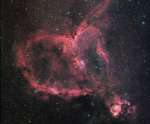 IC 1805: The Heart Nebula
13.02.2009
Sprawling across almost 200 light-years, emission nebula IC 1805 is a mix of glowing interstellar gas and dark dust clouds. Derived from its Valentine's-Day-approved shape, its nickname is the Heart Nebula. About 7,500 light-years away in the Perseus spiral arm of our galaxy, stars were born in IC 1805.
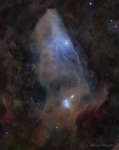 APOD: 2026 April 7 Б IC 4592: The Blue Horsehead Reflection Nebula
6.04.2026
Do you see the horse's head? What you are seeing is not the famous Horsehead nebula toward Orion, but rather a fainter nebula that only takes on a familiar form with deeper imaging. The main part of the here-imaged molecular cloud complex is reflection nebula IC 4592.
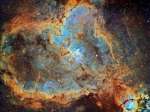 IC 1805: The Heart Nebula
4.03.2013
Sprawling across almost 200 light-years, emission nebula IC 1805 is a mix of glowing interstellar gas and dark dust clouds. Derived from its Valentine's-Day-approved shape, its nickname is the Heart Nebula. About 7,500 light-years away in the Perseus spiral arm of our galaxy, stars were born in IC 1805.
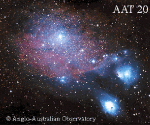 Nebulosity in Sagittarius
10.08.1997
What causes the colors in this beautiful nebulosity in Sagittarius? Dubbed NGC 6589 and NGC 6590, the colors of this nebulosity, are caused by gas and dust. The blue color of the nebula nearest the bright stars is caused by reflection off interstellar dust.
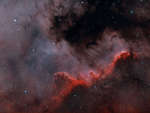 The Cygnus Wall of Star Formation
22.01.2013
The North America nebula on the sky can do what the North America continent on Earth cannot -- form stars. Specifically, in analogy to the Earth-confined continent, the bright part that appears as Central America and Mexico is actually a hot bed of gas, dust, and newly formed stars known as the Cygnus Wall.
|
January February March April May June July August September October |
|||||||||||||||||||||||||||||||||||||||||||||||||