
|
You entered: giant star
 NGC 7635: The Bubble Nebula Expanding
4.02.2018
It's the bubble versus the cloud. NGC 7635, the Bubble Nebula, is being pushed out by the stellar wind of massive star BD+602522, visible in blue toward the right, inside the nebula. Next door, though, lives a giant molecular cloud, visible to the far right in red.
 Stardust in Perseus
9.10.2015
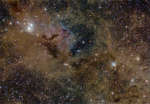
This cosmic expanse of dust, gas, and stars covers some 6 degrees on the sky in the heroic constellation Perseus. At upper left in the gorgeous skyscape is the intriguing young star cluster IC 348 and neighboring Flying Ghost Nebula.
 NGC 604: Giant Stellar Nursery
11.12.2012
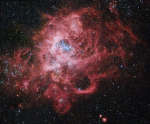
Stars are sometimes born in the midst of chaos. About 3 million years ago in the nearby galaxy M33, a large cloud of gas spawned dense internal knots which gravitationally collapsed to form stars. NGC 604 was so large, however, it could form enough stars to make a globular cluster.
 Stardust in Perseus
11.01.2023
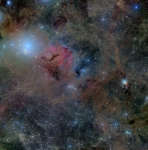
This cosmic expanse of dust, gas, and stars covers some 6 degrees on the sky in the heroic constellation Perseus. At upper left in the gorgeous skyscape is the intriguing young star cluster IC 348 and neighboring Flying Ghost Nebula with clouds of obscuring interstellar dust cataloged as Barnard 3 and 4.
 HD 189733b: Hot Jupiter
12.05.2007
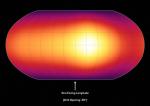
HD 189733b is a Jupiter-sized planet known to orbit a star some 63 light-years away. But while the distant world is approximately the size of Jupiter, its close-in orbit makes it much hotter than our solar system's ruling gas giant.
 Flare Well AR 10486
5.11.2003
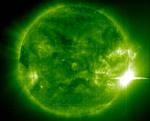
Almost out of view from our fair planet, rotating around the Sun's western edge, giant sunspot region AR 10486 lashed out with another intense solar flare followed by a large coronal mass ejection (CME) on Tuesday, November 4th at about 1950 Universal Time.
 Stars from Eagle's EGGs
12.04.1998
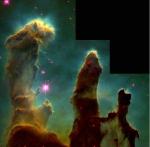
Newborn stars are forming in the Eagle Nebula. This image, taken with the Hubble Space Telescope in 1995, shows evaporating gaseous globules (EGGs) emerging from pillars of molecular hydrogen gas and dust. The giant pillars are light years in length and are so dense that interior gas contracts gravitationally to form stars.
 Stars from Eagles Eggs
2.05.1999
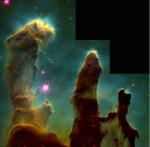
Newborn stars are forming in the Eagle Nebula. This image, taken with the Hubble Space Telescope in 1995, shows evaporating gaseous globules (EGGs) emerging from pillars of molecular hydrogen gas and dust. The giant pillars are light years in length and are so dense that interior gas contracts gravitationally to form stars.
 M16: Stars from Eagle's EGGs
24.11.2001
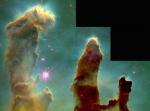
Newborn stars are forming in the Eagle Nebula. This image, taken with the Hubble Space Telescope in 1995, shows evaporating gaseous globules (EGGs) emerging from pillars of molecular hydrogen gas and dust. The giant pillars are light years in length and are so dense that interior gas contracts gravitationally to form stars.
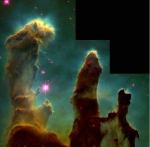 M16: Stars from Eagle's Eggs
24.09.2000
Newborn stars are forming in the Eagle Nebula. This image, taken with the Hubble Space Telescope in 1995, shows evaporating gaseous globules (EGGs) emerging from pillars of molecular hydrogen gas and dust. The giant pillars are light years in length and are so dense that
|
January February March April May June July August |
||||||||||||||||||||||||||||||||||||||||||||||||||||||||