
|
You entered: hot star
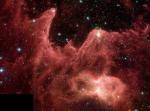 Mountains of Creation
11.11.2005
This fantastic skyscape lies at the eastern edge of giant stellar nursery W5, about 7,000 light-years away in the constellation Cassiopeia. An infrared view from the Spitzer Space Telescope, it features interstellar clouds...
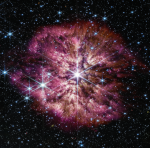 Wolf Rayet 124
18.03.2023
Driven by powerful stellar winds, expanding shrouds of gas and dust frame hot, luminous star Wolf-Rayet 124 in this sharp infrared view. The eye-catching 6-spike star pattern is characteristic of stellar images made with the 18 hexagonal mirrors of the James Webb Space Telescope.
 NGC 7293: The Helix Nebula
24.10.2024
A mere seven hundred light years from Earth toward the constellation Aquarius, a star is dying. The once sun-like star's last few thousand years have produced the Helix Nebula. Also known...
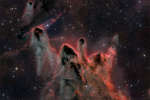 APOD: 2024 July 16 Б Cometary Globules
16.07.2024
What are these unusual interstellar structures? Bright-rimmed, flowing shapes gather near the center of this rich starfield toward the borders of the nautical southern constellations Pupis and Vela. Composed of interstellar gas and dust, the grouping of light-year sized cometary globules is about 1300 light-years distant.
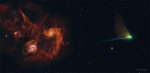 APOD: 2023 March 1 Б The Flaming Star Nebula
1.03.2023
Is star AE Aurigae on fire? No. Even though AE Aurigae is named the Flaming Star and the surrounding nebula IC 405 is named the Flaming Star Nebula, and even though the nebula appears to some like a swirling flame, there is no fire.
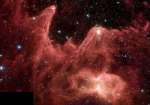 Mountains of Creation
15.12.2007
(xxxedit and linkxxx) This fantastic skyscape lies at the eastern edge of giant stellar nursery W5, about 7,000 light-years away in the constellation Cassiopeia. An infrared view from the Spitzer Space Telescope...
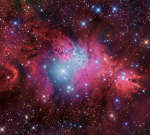 Fox Fur, Unicorn, and Christmas Tree
7.02.2019
Clouds of glowing hydrogen gas fill this colorful skyscape in the faint but fanciful constellation Monoceros, the Unicorn. A star forming region cataloged as NGC 2264, the complex jumble of cosmic gas and dust...
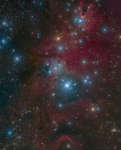 Fox Fur, a Unicorn, and a Christmas Tree
24.12.2016
Clouds of glowing hydrogen gas fill this colorful skyscape in the faint but fanciful constellation Monoceros, the Unicorn. A star forming region cataloged as NGC 2264, the complex jumble of cosmic gas and dust...
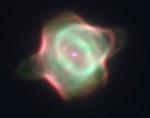 Hen 1357: New Born Nebula
6.10.2001
This Hubble Space Telescope snapshot shows Hen-1357, the youngest known planetary nebula. Graceful, gentle curves and symmetry suggest its popular name - The Stingray Nebula. Observations in the 1970s detected no nebular material, but this image from March 1996 clearly shows the Stingray's emerging bubbles and rings of shocked and ionized gas.
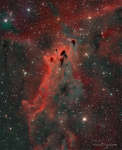 APOD: 2026 April 28 Б CG 30: Cometary Globules
28.04.2026
They're like mountain peaks, but they are forming stars. Bright-rimmed, flowing shapes gather near the center of this rich starfield toward the borders of the nautical southern constellations Puppis and Vela. Composed of interstellar gas and dust, the grouping of light-year sized cometary globules is about 1300 light-years distant.
|
January February March April May June July |
|||||||||||||||||||||||||||||||||||||||||||||||||