
|
You entered: sky
 Quadrantids
9.01.2019
Named for a forgotten constellation, the Quadrantid Meteor Shower is an annual event for planet Earth's northern hemisphere skygazers It usually peaks briefly in the cold, early morning hours of January 4. The shower's radiant on the sky lies within the old, astronomically obsolete constellation Quadrans Muralis.
 Meteor Fireballs in Light and Sound
15.03.2021
Yes, but have you ever heard a meteor? Usually, meteors are too far away to make any audible sound. However, a meteor will briefly create an ionization trail that can reflect a distant radio signal. If the geometry is right, you may momentarily hear -- through your radio -- a distant radio station even over static.
 APOD: 2025 June 4 Б A Milky Road to the Rubin Observatory
4.06.2025
Is the sky the same every night? No -- the night sky changes every night in many ways. To better explore how the night sky changes, the USA's NSF and DOE commissioned the Vera C. Rubin Observatory in Cerro PachцЁn, Chile.
 A Sirius Leonid Meteor
18.11.1999
In the sky or on the web, did you watch this year's Leonid meteor shower? If you did, meteors flashing through the night sky should be a familiar sight. Recorded last year during...
 Moon and Mars Tonight
23.12.2007
The Full Moon and a brilliant, ruddy Mars will share the sky tonight. Skygazers can easily enjoy the celestial pairing as the two are separated by a degree or even less. In fact, seen from parts of northern North America and Europe, the Moon will actually occult (pass in front of) the Red Planet.
 Retrograde Mars
11.05.2008
Why would Mars appear to move backwards? Most of the time, the apparent motion of Mars in Earth's sky is in one direction, slow but steady in front of the far distant stars. About every two years, however, the Earth passes Mars as they orbit around the Sun.
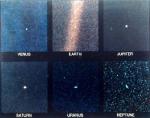 Our Solar System from Voyager
14.12.1996
After taking spectacular pictures of our Solar System's outer planets, Voyager 1 looked back at six planets to take our Solar System's first family portrait. Here Venus, Earth, Jupiter, Saturn, Uranus, and Neptune, were all visible across the sky.
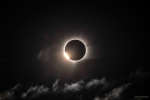 APOD: 2026 August 14 Б Total Solar Eclipse from Greenland
14.08.2026
On August 12, the Moon's shadow reached out to touch our fair planet. Beginning in the Arctic Ocean, it swept along a narrow track that led the dark lunar umbra across parts of Greenland, Iceland, the Atlantic, Portugal, and northern Spain.
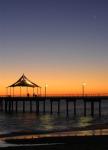 Three Planets by the Sea
2.07.2005
On Tuesday, June 28th, the setting Sun flooded the horizon with a beautiful warm light in this view from the beach beside the pier at Brighton in Adelaide, South Australia. The Sun also illuminated three planets gathered in the western sky, Mercury, Venus, and Saturn.
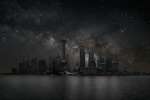 Darkened City
11.04.2013
In a haunting vista you can never see, bright stars and the central Milky Way rise over the dark skyline of metropolitan Pudong in Shanghai, China. Looking east across the Huangpu River, the cityscape includes Pudong's 470 meter tall Oriental Pearl Tower.
|
January February March April May June July August September October |
|||||||||||||||||||||||||||||||||||||||||||||||||