
|
You entered: image
 Curly Spiral Galaxy M63
22.05.2025
A bright spiral galaxy of the northern sky, Messier 63 is nearby, about 30 million light-years distant toward the loyal constellation Canes Venatici. Also cataloged as NGC 5055, the majestic island universe is nearly 100,000 light-years across, about the size of our own Milky Way.
 Andromeda and Friends
15.11.2025
This magnificent extragalactic skyscape looks toward the Andromeda Galaxy, the closest large spiral galaxy to the Milky Way. It also accomplishes a Messier catalog trifecta by including Andromeda, cataloged as Messier 31 (M31), along with Messier 32 (M32), and Messier 110 (M110) in the same telescopic field of view.
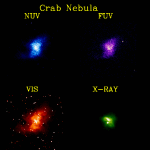 The High Energy Crab Nebula
9.09.1996
This is the mess that is left when a star explodes. The Crab Nebula is so energetic that it glows in every kind of light known. Shown above are images of the Crab Nebula from visible light to the X-ray band.
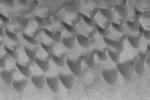 Sand Dunes on Mars
26.02.2001
Sand dunes on Mars can appear exotic. The dark dunes above might be compared to shark's teeth or chocolate confections. In reality, they arise from the complex relationship between the sandy surface and high winds on Mars.
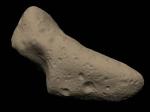 Asteroid Eros Reconstructed
5.06.2001
Orbiting the Sun between Mars and Earth, asteroid 433 Eros was visited by the robot spacecraft NEAR-Shoemaker in 2000 February. Some of the 100,000+ images taken by NEAR of the tumbling space rock have been combined into the above high-resolution composite.
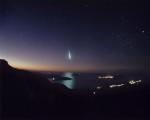 Mediterranean Leonid 2001
7.12.2001
A road trip from Ankara to the Mediterranean coast southeast of Antalya, Turkey found clear skies and splendid scenery for astrophotographer Tunc Tezel's viewing of the 2001 Leonid meteor storm. There he captured this dream-like image of a fireball meteor near the twilit horizon, reflected in calm ocean waters.
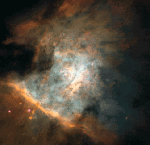 M42: Orion Nebula Mosaic
21.11.1995
The Great Nebula in Orion is one of the most interesting of all astronomical nebulae known. Here fifteen pictures from the Hubble Space Telescope have been merged to show the great expanse and diverse nature of the nebula.
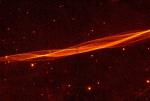 Filaments in the Cygnus Loop
18.01.2003
Subtle and delicate in appearance, these are filaments of shocked interstellar gas -- part of the expanding blast wave from a violent stellar explosion. Recorded in November 1997 with the Wide Field and Planetary Camera 2 on board the Hubble Space Telescope, the picture is a closeup of a supernova remnant known as the Cygnus Loop.
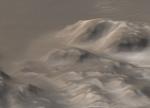 Frosty Mountains on Mars
30.07.2003
What causes the unusual white color on some Martian mountains? The answer can be guessed by noticing that the bright areas disappear as springtime takes hold in the south of Mars: dry ice. Unlike water ice, dry carbon dioxide ice sublimates directly to gas from its frozen state.
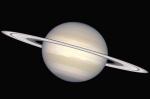 Natural Saturn On The Cassini Cruise
17.08.2003
What could you see approaching Saturn aboard an interplanetary cruise ship? Your view would likely resemble this subtly shaded image of the gorgeous ringed gas giant. Processed by the Hubble Heritage project, the picture...
|
January February March April May June July August September |
|||||||||||||||||||||||||||||||||||||||||||||||||