
|
You entered: Ring Nebula
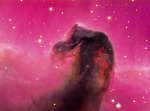 The Horsehead Nebula
27.12.2017
One of the most identifiable nebulae in the sky, the Horsehead Nebula in Orion, is part of a large, dark, molecular cloud. Also known as Barnard 33, the unusual shape was first discovered on a photographic plate in the late 1800s.
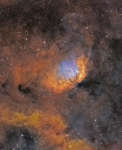 The Tulip in the Swan
14.11.2014
Framing a bright emission region this telescopic view looks out along the plane of our Milky Way Galaxy toward the nebula rich constellation Cygnus the Swan. Popularly called the Tulip Nebula the glowing cloud of interstellar gas and dust is also found in the 1959 catalog by astronomer Stewart Sharpless as Sh2-101.
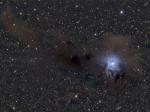 Wisps of the Iris Nebula
26.06.2007
Like delicate cosmic petals, these clouds of interstellar dust and gas have blossomed 1,300 light-years away in the fertile star fields of the constellation Cepheus. Sometimes called the Iris Nebula and dutifully cataloged as NGC 7023, this is not the only nebula in the sky to evoke the imagery of flowers.
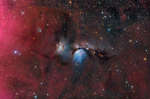 M78 Wide Field
29.12.2017
Interstellar dust clouds and glowing nebulae abound in the fertile constellation of Orion. One of the brightest, M78, is centered in this colorful, wide field view, covering an area north of Orion's belt. At a distance of about 1,500 light-years, the bluish reflection nebula is around 5 light-years across.
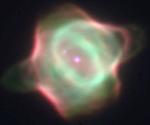 Hen 1357: New Born Nebula
3.04.1998
This Hubble Space Telescope picture shows Hen-1357, the youngest known planetary nebula. Graceful, gentle curves and symmetry suggest its popular name - The Stingray Nebula. Observations in the 1970s detected no nebular material, but this image from March 1996 clearly shows the Stingray's emerging bubbles and rings of shocked and ionized gas.
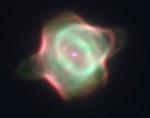 Hen 1357: New Born Nebula
6.10.2001
This Hubble Space Telescope snapshot shows Hen-1357, the youngest known planetary nebula. Graceful, gentle curves and symmetry suggest its popular name - The Stingray Nebula. Observations in the 1970s detected no nebular material, but this image from March 1996 clearly shows the Stingray's emerging bubbles and rings of shocked and ionized gas.
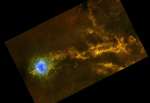 Herschel s Cocoon
19.08.2011
In this remarkable infrared skyscape of interstellar clouds adrift in the high flying constellation Cygnus, the eye is drawn to the Cocoon Nebula. Also known as IC5146, the dusty star forming region is shown...
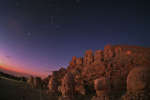 Orion Dawn Over Mount Nemrut
16.12.2008
What's that in front of Orion? Forty kilometers north of Kahta, Turkey, lies Mount Nemrut, a mountain adorned with the fragments of vast statues built over 2000 years ago. The stone sculptures once...
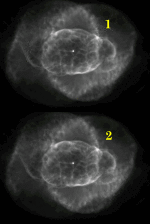 The Incredible Expanding Cats Eye
16.09.1999
Watch closely. As this animation blinks between two Hubble Space Telescope images of NGC 6543 - the first from 1994 and the second from 1997 - the intricate filaments of this nebula are seen to shift. The shift is due to the actual expansion of this gaseous shroud shed by a dying star!
 Iron in the Butterfly Nebula
21.07.2020
Can stars, like caterpillars, transform themselves into butterflies? No, but in the case of the Butterfly Nebula -- it sure looks like it. Though its wingspan covers over 3 light-years and its estimated surface temperature...
|
January February March April May June July August September October |
|||||||||||||||||||||||||||||||||||||||||||||||||