
|
You entered: cluster gas
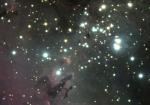 Blue Stars and Red Pillars
18.07.1997
Bright blue stars are still forming in the red pillars of the Eagle Nebula. Made famous by a picture from the Hubble Space Telescope in 1995, the Eagle Nebula shows the dramatic process of star formation. To the upper right of the nebula in the above picture lies the heart of the open cluster M16.
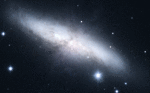 Unusual M82: The Cigar Galaxy
15.03.1998
Something strange happened to this galaxy, but what? M82 is a nearby galaxy in the group of galaxies dominated by itself, M81, and NGC 3077. M82 is thought by some to be limping away from a close encounter with M81.
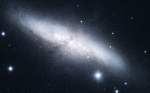 Unusual M82: The Cigar Galaxy
18.11.1996
Something strange happened to this galaxy, but what? M82 is a nearby galaxy in the group of galaxies dominated by itself, M81, and NGC 3077. M82 is thought by some to be limping away from a close encounter with M81.
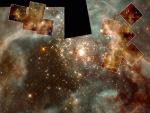 Massive Stars of 30 Doradus
22.06.2003
In the center of star-forming region 30 Doradus lies a huge cluster of the largest, hottest, most massive stars known. These stars and part of the surrounding nebula are captured here in this gorgeous visible-light Hubble Space Telescope image.
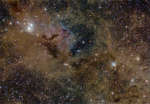 Stardust in Perseus
10.10.2015
This cosmic expanse of dust, gas, and stars covers some 6 degrees on the sky in the heroic constellation Perseus. At upper left in the gorgeous skyscape is the intriguing young star cluster IC 348 and neighboring Flying Ghost Nebula.
 APOD: 2025 February 25 Б M41: The Little Beehive Star Cluster
25.02.2025
Why are there so many bright blue stars? Stars are usually born in clusters, and the brightest and most massive of these stars typically glow blue. Less-bright, non-blue stars like our Sun surely also exist in this M41 star cluster but are harder to see. A few bright orange-appearing red giant stars are visible.
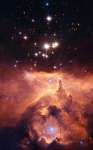 NGC 6357s Cathedral to Massive Stars
18.11.2012
How massive can a normal star be? Estimates made from distance, brightness and standard solar models had given one star in the open cluster Pismis 24 over 200 times the mass of our Sun, nearly making it the record holder.
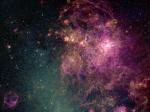 30 Doradus: The Tarantula Zone
12.12.2005
The Tarantula Nebula is more than 1,000 light-years across - a giant emission nebula within our neighboring galaxy the Large Magellanic Cloud. Inside this cosmic arachnid lies a central young cluster of massivestars, cataloged as R136, whose intense radiation and strong winds have helped energize the nebular glow and shape the spidery filaments.
 APOD: 2025 July 8 Б The Pleiades in Red and Blue
8.07.2025
If you have looked at the sky and seen a group of stars about the size of the full Moon, that's the Pleiades (M45). Perhaps the most famous star cluster in the sky, its brightest stars can be seen even from the light-polluted cities.
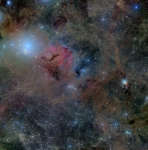 Stardust in Perseus
12.01.2023
This cosmic expanse of dust, gas, and stars covers some 6 degrees on the sky in the heroic constellation Perseus. At upper left in the gorgeous skyscape is the intriguing young star cluster IC 348 and neighboring Flying Ghost Nebula with clouds of obscuring interstellar dust cataloged as Barnard 3 and 4.
|
January February March April May June July August |
||||||||||||||||||||||||||||||||||||||||||||||||||||||||