
|
You entered: dark cloud
 APOD: 2024 December 9 Б Pleiades: The Seven Sisters Star Cluster
9.12.2024
Have you ever seen the Pleiades star cluster? Even if you have, you probably have never seen it as large and clear as this. Perhaps the most famous star cluster on the sky, the bright stars of the Pleiades can be seen with the unaided eye even from the depths of a light-polluted city.
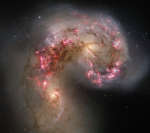 The Antennae Galaxies in Collision
18.07.2010
Two galaxies are squaring off in Corvus and here are the latest pictures. But when two galaxies collide, the stars that compose them usually do not. That's because galaxies are mostly empty space and, however bright, stars only take up only a small amount of that space.
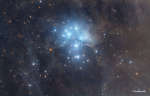 M45: The Pleiades Star Cluster
19.10.2016
Have you ever seen the Pleiades star cluster? Even if you have, you probably have never seen it as dusty as this. Perhaps the most famous star cluster on the sky, the bright stars of the Pleiades can be seen without binoculars even from the heart of a light-polluted city.
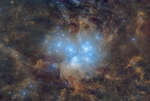 APOD: 2026 February 23 Б Pleiades: The Seven Sisters Star Cluster
23.02.2026
Have you ever seen the Pleiades star cluster? Even if you have, you probably have never seen it as large and clear as this. Perhaps the most famous star cluster on the sky, the bright stars of the Pleiades can be seen with the unaided eye even from the depths of a light-polluted city.
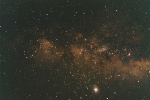 Hale-Bopp, Jupiter, and the Milky Way
23.07.1996
Shining brightly, the mighty Jupiter rules this gorgeous Kodacolor photo of the Milky Way near Sagittarius. Astronomer Bill Keel took the picture earlier this month (July 7) while standing near the summit of Hawaii's Mauna Kea contemplating the sky in the direction of the center of the Galaxy (right of picture center).
 APOD: 2024 June 11 Б Colorful Stars and Clouds near Rho Ophiuchi
11.06.2024
Why is the sky near Antares and Rho Ophiuchi so colorful, yet dusty? The colors result from a mixture of objects and processes. Fine dust -- illuminated by starlight -- produces blue reflection nebulae. Gaseous clouds whose atoms are excited by ultraviolet starlight produce reddish emission nebulae. Backlit dust clouds block starlight and so appear dark.
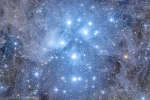 Pleiades: The Seven Sisters Star Cluster
5.12.2022
Have you ever seen the Pleiades star cluster? Even if you have, you probably have never seen it as large and clear as this. Perhaps the most famous star cluster on the sky, the bright stars of the Pleiades can be seen with the unaided eye even from the depths of a light-polluted city.
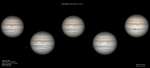 Jupiter and Io
28.11.2012
On December 3 (UT), Jupiter, the solar system's largest planet, will be at opposition, opposite the Sun in planet Earth's sky, shining brightly and rising as the Sun sets. That configuration results in Jupiter's almost annual closest approach to planet Earth.
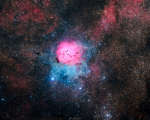 A Beautiful Trifid
5.08.2022
The beautiful Trifid Nebula is a cosmic study in contrasts. Also known as M20, it lies about 5,000 light-years away toward the nebula rich constellation Sagittarius. A star forming region in the plane...
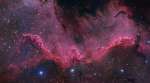 Along the Cygnus Wall
11.03.2015
The W-shaped ridge of emission featured in this vivid skyscape is known as the Cygnus Wall. Part of a larger emission nebula with a distinctive outline popularly called The North America Nebula, the cosmic ridge spans about 20 light-years.
|
January February March April May June July August September October |
|||||||||||||||||||||||||||||||||||||||||||||||||