
|
You entered: image
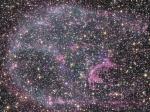 Supernova Remnant N132D in Optical and X Rays
25.10.2005
Thousands of years after a star exploded, its expanding remnant still glows brightly across the spectrum. Such is the case with N132D, a supernova remnant located in the neighboring Large Magellanic Cloud (LMC) galaxy. The expanding shell from this explosion now spans 80 light-years and has swept up about 600 Suns worth of mass.
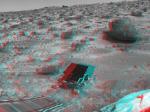 Mars: Yogi And Friends in 3D
16.07.1997
A ramp from the Pathfinder lander, the Sojourner robot rover, airbags, a couch, Barnacle Bill, and Yogi Rock appear together in this 3D stereo view of the surface of Mars. Barnacle Bill is the rock just left of the solar-paneled Sojourner and Yogi is the big friendly-looking boulder at the right.
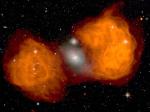 The Giant Radio Lobes of Fornax A
28.06.2005
Together, the radio lobes span over one million light years -- what caused them? In the center is a large but peculiar elliptical galaxy dubbed NGC 1316. Detailed inspection of the NGC 1316 system indicates that it began absorbing a small neighboring galaxy about 100 million years ago.
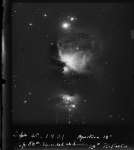 1901 Photograph: The Orion Nebula
17.08.2019
By the turn of the 20th century advances in photography contributed an important tool for astronomers. Improving photographic materials, long exposures, and new telescope designs produced astronomical images with details not visible at the telescopic eyepiece alone.
 Moons and Rings Before Saturn
31.05.2010
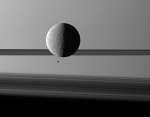
While cruising around Saturn, be on the lookout for picturesque juxtapositions of moons and rings. Another striking alignment occurred last March in the view of humanity's Saturn-orbiting Cassini spacecraft. Rhea, one of Saturn's larger moons, was caught passing Epimetheus, one of Saturn's smaller moons.
 Sunspot Metamorphosis: From Bottom to Top
16.02.2005
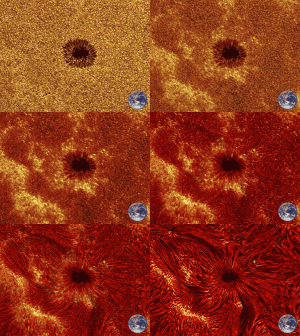
Sunspots -- magnets the size of the Earth -- are normally seen flat on the Sun. The above digital metamorphosis, however, shows a sunspot as it appears at increasing heights, effectively in three dimensions. The above...
 Distant Galaxies
7.09.1995
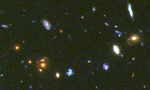
This Hubble Space Telescope image of a group of faint galaxies "far, far away" is a snap shot of the Universe when it was young. The bluish, irregularly shaped galaxies revealed in the image are up to eight billion light years away and seem to have commonly undergone galaxy collisions and bursts of star formation.
 The Rings of Saturn
30.07.1995
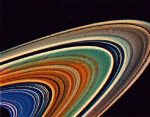
Saturn's spectacular system of bright rings has been the subject of study and wonder since Galileo first turned his telescope on the ringed planet in 1610. To Galileo, the blurry image produced by his small telescope was confusing. Saturn appeared to him to have "ear-like" appendages which he thought might be large moons.
 Retrograde Mars
16.12.2003
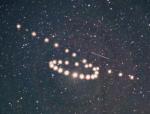
Why would Mars appear to move backwards? Most of the time, the apparent motion of Mars in Earth's sky is in one direction, slow but steady in front of the far distant stars. About every two years, however, the Earth passes Mars as they orbit around the Sun.
 A Shadow on the Rings of Saturn
21.07.2004
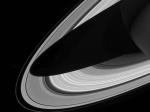
This picture of Saturn could not have been taken from Earth. No Earth based picture could possibly view the night side of Saturn and the corresponding shadow cast across Saturn's rings. Since Earth is much closer to the Sun than Saturn, only the day side of the planet is visible from the Earth.
|
January February March April May June July August September |
|||||||||||||||||||||||||||||||||||||||||||||||||