
|
You entered: interstellar dust
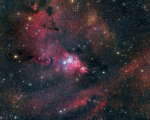 Cosmic Clouds in the Unicorn
7.02.2020
Interstellar clouds of hydrogen gas and dust abound in this gorgeous skyscape. The 3 degree wide field of view stretches through the faint but fanciful constellation Monoceros, the Unicorn. A star forming region cataloged as NGC 2264 is centered, a complex jumble of cosmic gas, dust and stars about 2,700 light-years distant.
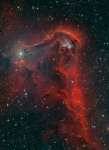 RCW 85
13.06.2024
From the 1960 astronomical catalog of Rodgers, Campbell and Whiteoak, emission region RCW 85 shines in southern night skies between bright stars Alpha and Beta Centauri. About 5,000 light years distant, the hazy interstellar cloud of glowing hydrogen gas and dust is faint.
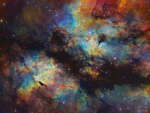 IC 1318: The Butterfly Nebula in Gas and Dust
15.03.2021
In the constellation of the swan near the nebula of the pelican lies the gas cloud of the butterfly next to a star known as the hen. That star, given the proper name Sadr...
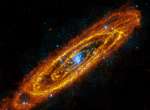 The Once and Future Stars of Andromeda
19.01.2011
The big, beautiful Andromeda Galaxy, aka M31, is a spiral galaxy a mere 2.5 million light-years away. Two space-based observatories have combined to produce this intriguing composite image of Andromeda, at wavelengths outside the visible spectrum. The remarkable view follows the locations of this galaxy's once and future stars.
 Snake in the Dark
21.05.2005
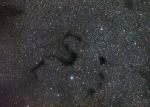
Dark nebulae snake across a gorgeous expanse of stars in this wide-field view toward the pronounceable constellation Ophiucus and the center of our Milky Way Galaxy. In fact, the central S-shape seen here is well known as the Snake Nebula.
 Snake in the Dark
20.06.2003
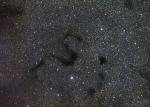
Dark nebulae snake across a gorgeous expanse of stars in this wide-field view toward the pronounceable constellation Ophiucus and the center of our Milky Way Galaxy. In fact, the central S-shape seen here is well known as the Snake Nebula.
 Nebulas Surrounding Wolf Rayet Binary
BAT99 49
Nebulas Surrounding Wolf Rayet Binary
BAT99 49
21.04.2004
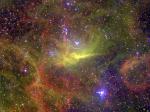
How could two young stars power these colorful interstellar gas clouds? Although hidden by thick dust, the stars spew forceful ions and energetic radiation that cause the clouds to fragment and light up.
 Snake in the Dark
19.02.2009
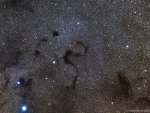
Dark nebulae snake across a gorgeous expanse of stars in this telescopic view toward the pronounceable constellation Ophiuchus and the center of our Milky Way Galaxy. In fact, the twisting central shape seen here is well known as the Snake Nebula.
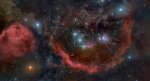 Orion: Head to Toe
23.10.2010
Cradled in cosmic dust and glowing hydrogen, stellar nurseries in Orion the Hunter lie at the edge of a giant molecular cloud some 1,500 light-years away. Spanning nearly 25 degrees, this breath-taking vista stretches across the well-known constellation from head to toe (left to right).
 The Clouds of Orion the Hunter
15.03.2015
Cradled in cosmic dust and glowing hydrogen, stellar nurseries in Orion the Hunter lie at the edge of giant molecular clouds some 1,500 light-years away. Spanning about 30 degrees, this breath-taking vista stretches across the well-known constellation from head to toe (left to right) and beyond.
|
January February March April May June July August September |
|||||||||||||||||||||||||||||||||||||||||||||||||