
|
You entered: night sky
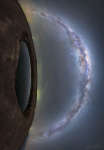 APOD: 2026 April 19 Б Eye on the Milky Way
19.04.2026
Have you ever had stars in your eyes? It appears that the eye on the left does, and moreover, it appears to be gazing at even more stars. The featured 27-frame mosaic was taken in 2019 from Ojas de Salar in the Atacama Desert of Chile.
 Night of the Perseids
14.08.2010
On the night of August 12, from moonset until dawn was a good time to see meteors. Enthusiasts watched as comet dust rained on planet Earth, streaking through dark skies during the annual Perseid Meteor Shower.
 Halley Dust and Milky Way
10.05.2019
Grains of cosmic dust streaked through the mostly moonless night skies of May 7. Swept up as planet Earth plowed through the debris streams left behind by periodic Comet Halley, the annual meteor shower is known as the Eta Aquarids.
 APOD: 2024 August 19 Б IC 5146: The Cocoon Nebula
19.08.2024
Inside the Cocoon Nebula is a newly developing cluster of stars. Cataloged as IC 5146, the beautiful nebula is nearly 15 light-years wide. Soaring high in northern summer night skies, it's located some 4,000 light years away toward the constellation of the Swan (Cygnus).
 NGC 6302: The Butterfly Nebula
6.06.2025
The bright clusters and nebulae of planet Earth's night sky are often given the names of flowers or insects, and its whopping 3 light-year wingspan, NGC 6302 is no exception. With an estimated...
 APOD: 2025 May 20 Б Milky Way over Maunakea
20.05.2025
Have you ever seen the band of our Milky Way Galaxy? In a clear sky from a dark location at the right time, a faint band of light becomes visible across the sky. Soon after your eyes become dark adapted, you might spot the band for the first time. It may then become obvious.
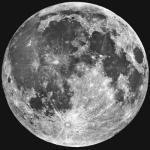 The Full Moon
19.04.1999
Earth has one moon. A symbol in famous love songs, movies, poems, and folklore, many myths about the Moon date back to ancient history. In fact, the name Monday originates from Moon-day. The Moon glows by light it reflects from the Sun and is frequently the brightest object in the night sky.
 Cassini Flyby
26.08.1999
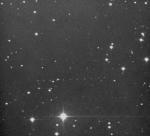
Connect the dots and you'll trace the path of the Cassini spacecraft as it took a final turn by Earth on its way to the outer solar system. The dots (in a horizontal row just below center) are actually successive images of the spacecraft.
 Time Lapse Clouds and Sky Over the Canary Islands
16.05.2011
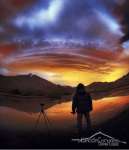
If you could sit back and watch clouds and the sky move all night and day, what might you see? One answer from the island of Tenerife, captured over the course of the year, includes sequences that are not only breathtaking but instructive.
 Alpha Centauri: The Closest Star System
23.03.2003
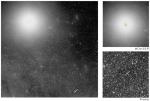
The closest star system to the Sun is the Alpha Centauri system. Of the three stars in the system, the dimmest -- called Proxima Centauri -- is actually the nearest star. The bright stars Alpha Centauri...
|
January February March April May June July August September October |
|||||||||||||||||||||||||||||||||||||||||||||||||