
|
You entered: Earth
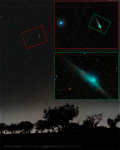 APOD: 2023 January 31 Б A Triple View of Comet ZTF
31.01.2023
Comet ZTF has a distinctive shape. The now bright comet visiting the inner Solar System has been showing not only a common dust tail, ion tail, and green gas coma, but also an uncommonly distinctive antitail.
 APOD: 2025 September 1 Б Callisto: Dirty Battered Iceball
1.09.2025
Its surface is the most densely cratered in the Solar System -- but what's inside? Jupiter's moon Callisto is a battered ball of dirty ice that is larger than the planet Mercury.
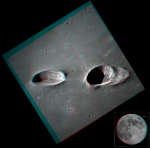 APOD: 2026 May 9 Б Messier Craters in Stereo
9.05.2026
Many bright nebulae and star clusters in planet Earth's sky are associated with the name of astronomer Charles Messier from his famous 18th century catalog. His name is also given to these two large and remarkable craters on the Moon.
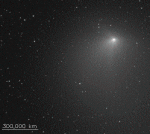 Comet Hale-Bopp Fades
17.09.1996
Comet Hale-Bopp has faded in the past few weeks. For Hale-Bopp, promised as the Great Comet of 1997, this was a bit of a disappointment -- but not entirely unexpected. Comet Hale-Bopp continues to approach...
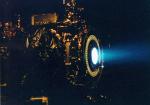 An Ion Drive for Deep Space 1
20.07.2003
Space travel entered the age of the ion drive in 1998 with the launch of Deep Space 1, a NASA mission designed primarily to test new technologies. Although the ion drive on Deep Space...
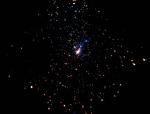 X Ray Stars in the Orion Nebula
19.05.2005
When our middle-aged Sun was just a few million years old it was thousands of times brighter in x-rays. In fact, it was likely similar to some of the stars found in this false-color x-ray composite of the Orion Nebula region from the Chandra Observatory.
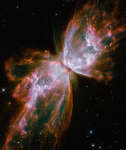 NGC 6903: The Butterfly Nebula
7.06.2013
The bright clusters and nebulae of planet Earth's night sky are often named for flowers or insects. Though its wingspan covers over 3 light-years, NGC 6302 is no exception. With an estimated surface...
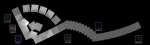 Solar System Portrait
13.02.2015
On another Valentine's Day 25 years ago, cruising four billion miles from the Sun, the Voyager 1 spacecraft looked back one last time to make this first ever Solar System family portrait. The complete portrait is a 60 frame mosaic made from a vantage point 32 degrees above the ecliptic plane.
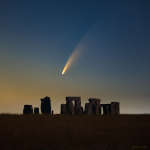 Comet NEOWISE over Stonehenge
14.07.2020
Have you ever seen a comet? Tonight -- and likely the next few nights -- should be a good chance. Go outside just at sunset and look to your northwest. The lower your horizon, the better. Binoculars may help, but if your sky is cloudless and dark, all you should need is your unaided eyes and patience.
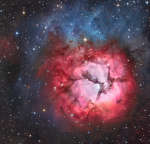 A Beautiful Trifid
12.08.2021
The beautiful Trifid Nebula is a cosmic study in contrasts. Also known as M20, it lies about 5,000 light-years away toward the nebula rich constellation Sagittarius. A star forming region in the plane...
|
January February March April May June July August September October |
|||||||||||||||||||||||||||||||||||||||||||||||||