
|
You entered: star
 Meteor Borealis
16.08.2024
A single exposure made with a camera pointed almost due north on August 12 recorded this bright Perseid meteor in the night sky west of Halifax, Nova Scotia, Canada. The meteor's incandescent trace is fleeting.
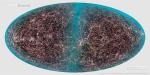 The 2MASS Galaxy Sky
17.09.2003
Are the nearest galaxies distributed randomly? A plot of over one million of the brightest "extended sources" detected by the Two Micron All Sky Survey (2MASS) shows that they are not. The vast majority of these infrared extended sources are galaxies.
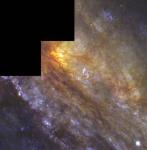 NGC 253: The Sculptor Galaxy
9.12.1998
NGC 253 is not only one of the brightest spiral galaxies visible, it is also one of the dustiest. Discovered in 1783 by Caroline Herschel in the constellation of Sculptor, NGC 253 lies only about ten million light-years distant.
 Conjunction at Sunset
29.12.2011
While Comet Lovejoy entertained early morning risers in in the southern hemisphere, a lovely conjunction of a young crescent Moon and Venus graced western skies at sunset. Captured on December 26th the conjunction, with beautiful sunset colors above and below, is seen here over Viverone Lake near Turin, Italy.
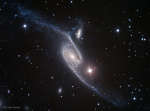 NGC 6872: A Stretched Spiral Galaxy
26.04.2016
What makes this spiral galaxy so long? Measuring over 700,000 light years across from top to bottom, NGC 6872, also known as the Condor galaxy, is one of the most elongated barred spiral galaxies known.
 NGC 289: Swirl in the Southern Sky
15.10.2021
About 70 million light-years distant, gorgeous spiral galaxy NGC 289 is larger than our own Milky Way. Seen nearly face-on, its bright core and colorful central disk give way to remarkably faint, bluish spiral arms. The extensive arms sweep well over 100 thousand light-years from the galaxy's center.
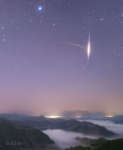 APOD: 2026 January 12 Б Meteor Dust
12.01.2026
What's happening to this meteor? It is shedding its outer layers as it passes through the Earth's atmosphere and heats up. The sudden high temperatures not only cause the bright glow along the dramatic streak but also melt and vaporize the meteor's component rock and ice, creating dust.
 Maria Mitchell Inspires a Generation
1.10.1997
"Do not look at stars as bright spots only - try to take in the vastness of the universe." Today is the 150th anniversary of the day Maria Mitchell swept the sky with her telescope and discovered the comet of 1847 (comet Mitchell 1847VI).
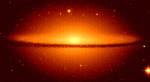 M104: The Sombrero Galaxy
9.11.1995
The famous Sombrero galaxy (M104) is a bright nearby spiral galaxy. The prominent dust lane and halo of stars and globular clusters give this galaxy its name. Something very energetic is going on in the Sombrero's center, as much X-ray light has been detected from it.
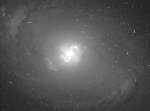 NGC 3393: A Super Spiral?
4.08.1996
A bird? A plane? No, but pictured here is something physically much larger, flying much higher, and moving much faster than either of these. It is, in fact, a Seyfert type 2 spiral galaxy. The "S" is actually a lane of stars, gas and dust circling the core.
|
January February March April May June July August September October |
|||||||||||||||||||||||||||||||||||||||||||||||||