
|
You entered: stars
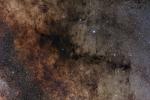 East of Antares
23.06.2006
East of Antares, dark markings seem to sprawl through the crowded star fields toward the center of our Milky Way Galaxy. Cataloged in the early 20th century by astronomer E. E. Barnard, the obscuring interstellar dust clouds include B72, B77, B78, and B59, seen in silhouette against the starry background.
 Maria Mitchell Inspires a Generation
16.10.1999
"Do not look at stars as bright spots only - try to take in the vastness of the universe." On October 1, 1847 Maria Mitchell swept the sky with her telescope and discovered a comet (comet Mitchell 1847VI).
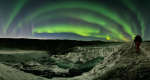 Waterfalls, Auroras, Comet: Iceland
26.03.2013
If not distracted by the picturesque landscape, waterfalls, stars, and auroras, you might be able to find Comet PANSTARRS. The above image, capturing multiple terrestrial and celestial wonders in a single shot, was taken last week in southwest Iceland.
 Across the Sun
30.04.2015
A long solar filament stretches across the relatively calm surface of the Sun in this telescopic snap shot from April 27. The negative or inverted narrowband image was made in the light of ionized hydrogen atoms.
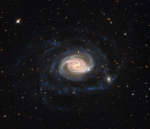 NGC 289: Swirl in the Southern Sky
5.04.2018
About 70 million light-years distant, gorgeous spiral galaxy NGC 289 is larger than our own Milky Way. Seen nearly face-on, its bright core and colorful central disk give way to remarkably faint, bluish spiral arms. The extensive arms sweep well over 100 thousand light-years from the galaxy's center.
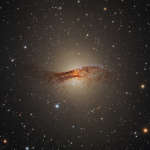 Centaurus A
12.07.2018
Only 11 million light-years away, Centaurus A is the closest active galaxy to planet Earth. Spanning over 60,000 light-years, the peculiar elliptical galaxy also known as NGC 5128, is featured in this sharp telescopic view.
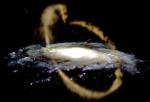 The Sagittarius Dwarf Tidal Stream
30.09.2003
Is our Milky Way Galaxy out to lunch? Recent wide field images and analyses now indicate that our home galaxy is actually still in the process of devouring its closest satellite neighbor. This unfortunate...
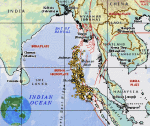 The Powerful Sumatra Andaman Islands Earthquake
2.03.2005
December's 9.0 earthquake has likely shortened Earth's day by about three microseconds and may also have tweaked Earth's rotational wobble. The megathrust earthquake occurred as the Indian tectonic plate slid further beneath the Burma tectonic plate.
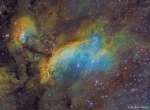 IC 4628: The Prawn Nebula
4.07.2016
South of Antares, in the tail of the nebula-rich constellation Scorpius, lies emission nebula IC 4628. Nearby hot, massive stars, millions of years young, radiate the nebula with invisible ultraviolet light, stripping electrons from atoms. The electrons eventually recombine with the atoms to produce the visible nebular glow, dominated by the red emission of hydrogen.
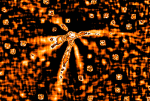 Seven Jets from Comet Hale-Bopp
13.11.1996
Comet Hale-Bopp is turning out to be quite unusual. One reason is the great amount of jet activity at such a large distance from the Sun. In the above false-color image, no less than seven jets can be seen emanating from Hale-Bopp's coma.
|
January February March April May June July August September October |
|||||||||||||||||||||||||||||||||||||||||||||||||