
|
You entered: apod
 APOD: 2025 February 24 Б Light Pillar over Erupting Etna
24.02.2025
Can a lava flow extend into the sky? No, but light from the lava flow can. One effect is something quite unusual -- a volcanic light pillar. More typically, light pillars are caused by sunlight and so appear as a bright column that extends upward above a rising or setting Sun.
 APOD: 2025 July 5 Б Ou4: The Giant Squid Nebula
5.07.2025
Difficult to capture, this mysterious, squid-shaped interstellar cloud spans nearly three full moons in planet Earth's sky. Discovered in 2011 by French astro-imager Nicolas Outters, the Squid Nebula's bipolar shape is distinguished here by the telltale blue emission from doubly ionized oxygen atoms.
 APOD: 2025 July 19 Б Messier 6
19.07.2025
The sixth object in Charles Messier's famous catalog of things which are not comets, Messier 6 is a galactic or open star cluster. A gathering of 100 stars or so, all around 100 million years young, M6 lies some 1,600 light-years away toward the central Milky Way in the constellation Scorpius.
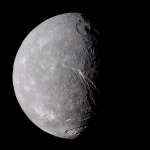 APOD: 2026 March 31 Б Uranus Largest Moon: Titania
31.03.2026
Titania's tortured terrain is a mix of canyons, cliffs, and craters. NASA's interplanetary robot spacecraft Voyager 2 passed the largest moon of Uranus in 1986 and took the feature picture. That...
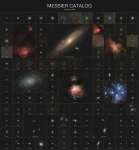 APOD: 2026 May 14 Б The Messier Catalog at Uniform Scale
14.05.2026
What are some of the most interesting astronomical objects you can see in the night sky? Armed with a good pair of binoculars or a small telescope, if you live in the Northern Hemisphere, you can look for the very popular objects in the Messier Catalog.
 APOD: 2025 May 27 Б Zeta and Rho Ophiuchi with Milky Way
27.05.2025
Behold one of the most photogenic regions of the night sky, captured impressively. Featured, the band of our Milky Way Galaxy runs diagonally along the bottom-left corner, while the colorful Rho Ophiuchi cloud complex is visible just right of center and the large red circular Zeta Ophiuchi Nebula appears near the top.
 APOD: 2023 August 22 Б The Pistachio Nebula
22.08.2023
This nebula had never been noted before. Newly discovered nebulas are usually angularly small and found by professionals using large telescopes. In contrast, the Pistachio Nebula was discovered by dedicated amateurs and, although faint, is nearly the size of the full Moon.
 APOD: 2023 August 28 Б Star Formation in the Pacman Nebula
28.08.2023
Look through the cosmic cloud cataloged as NGC 281 and you might miss the stars of open cluster IC 1590. Formed within the nebula, that cluster's young, massive stars ultimately power the pervasive nebular glow.
 APOD: 2023 December 6 Б Stars Verus Dust in the Carina Nebula
6.12.2023
It's stars versus dust in the Carina Nebula and the stars are winning. More precisely, the energetic light and winds from massive newly formed stars are evaporating and dispersing the dusty stellar nurseries in which they formed.
 APOD: 2024 September 16 Б Mercurys Vivaldi Crater from BepiColombo
16.09.2024
Why does this large crater on Mercury have two rings and a smooth floor? No one is sure. The unusual feature called Vivaldi Crater spans 215 kilometers and was imaged again in great detail by ESA's and JAXA's robotic BepiColombo spacecraft on a flyby earlier this month.
|
January February March April May June July August |
||||||||||||||||||||||||||||||||||||||||||||||||||||||||