
|
You entered: black hole
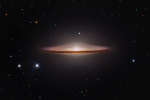 M104: The Sombrero Galaxy
4.02.2015
The striking spiral galaxy M104 is famous for its nearly edge-on profile featuring a broad ring of obscuring dust lanes. Seen in silhouette against an extensive bulge of stars, the swath of cosmic dust lends a broad brimmed hat-like appearance to the galaxy suggesting the more popular moniker, The Sombrero Galaxy.
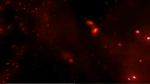 An Immersive Visualization of the Galactic Center
22.01.2018
What if you could look out from the center of our Galaxy -- what might you see? Two scientifically-determined possibilities are shown in the featured video, an immersive 360-degree view which allows you to look around in every direction.
 Journey to the Center of the Galaxy
11.04.2004
In Jules Verne's science fiction classic A Journey to the Center of the Earth, Professor Hardwigg and his fellow explorers encounter many strange and exciting wonders. What wonders lie at the center of our Galaxy?
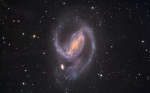 In the Arms of NGC 1097
8.01.2015
Spiral galaxy NGC 1097 shines in southern skies, about 45 million light-years away in the chemical constellation Fornax. Its blue spiral arms are mottled with pinkish star forming regions in this colorful galaxy portrait.
 APOD: 2025 March 11 Б NGC 1672: Barred Spiral Galaxy from Hubble
11.03.2025
Many spiral galaxies have bars across their centers. Even our own Milky Way Galaxy is thought to have a modest central bar. Prominently barred spiral galaxy NGC 1672, featured here, was captured in spectacular detail in an image taken by the orbiting Hubble Space Telescope.
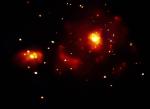 M51: X Rays from the Whirlpool
11.07.2002
Fresh from yesterday's episode, a popular pair of interacting galaxies known as the Whirlpool debut here beyond the realm of visible light -- imaged at high energies by the orbiting Chandra X-ray Observatory. Still turning in a remarkable performance, over 80 glitering x-ray stars are present in the Chandra image data from the region.
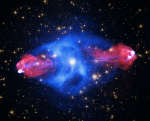 Light from Cygnus A
23.01.2015
Celebrating astronomy in this International Year of Light, the detailed image reveals spectacular active galaxy Cygnus A in light across the electromagnetic spectrum. Incorporating X-ray data ( blue) from the orbiting Chandra Observatory, Cygnus A is seen to be a prodigious source of high energy x-rays.
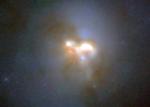 Arp 220: Spirals in Collision
17.06.1997
Arp 220 is the brightest object in the local universe. But why does it shine so brightly? Arp 220 was cataloged as a peculiar galaxy in the 1960s. In the late 1980s, it was discovered to be an ultraluminous infrared galaxy and headed a list compiled from observations with the now-defunct IRAS satellite.
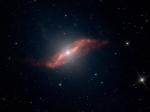 The Galaxy Within Centaurus A
24.06.2004
Peering deep inside Centaurus A, the closest active galaxy to Earth, the Spitzer Space Telescope's penetrating infrared cameras recorded this startling vista. About 1,000 light-years across, the twisted cosmic dust cloud apparently shaped like a parallelogram is likely the result of a smaller spiral galaxy falling into the giant Centaurus A.
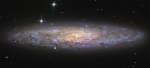 NGC 253: Dusty Island Universe
22.03.2018
Shiny NGC 253 is one of the brightest spiral galaxies visible, and also one of the dustiest. Some call it the Silver Dollar Galaxy for its appearance in small telescopes, or just the Sculptor Galaxy for its location within the boundaries of the southern constellation Sculptor.
|
January February March April May June July August September October |
|||||||||||||||||||||||||||||||||||||||||||||||||