
|
You entered: crater
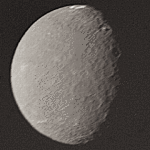 Uranus's Moon Umbriel: A Mysterious Dark World
7.04.1996
Why is Umbriel so dark? This dark moon reflects only half the light of other Uranus' moons such as Ariel. And what is that bright ring at the top? Unfortunately, nobody yet knows. These questions presented themselves when Voyager 2 passed this satellite of Uranus in January 1986.
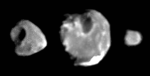 Jupiters Moons Thebe, Amalthea, and Metis
8.05.2000
The robot spacecraft Galileo in orbit around Jupiter has recently photographed the inner moons of Jupiter in greater detail than ever before. These pictures of Thebe, Amalthea, and Metis are shown to scale, and reveal details as small as three kilometers across. Amalthea, by contrast, has a total length of about 200 kilometers.
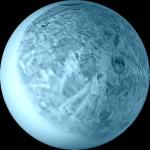 Hamlet of Oberon
31.01.1998
What's in a name? Since 1919, the International Astronomical Union has been charged with the task of establishing "conventional" nomenclature for planets, satellites, and surface features. For the remote Uranian system of moons, namesakes from Shakespearean works have been chosen.
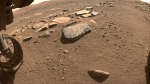 Mars Rock Rochette
28.08.2021
Taken on mission sol 180 (August 22) this sharp image from a Hazard Camera on the Perseverance rover looks out across a rock strewn floor of Jezero crater on Mars. At 52.5 centimeters (21 inches) in diameter, one of the rover's steerable front wheels is at lower left in the frame.
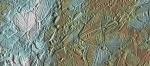 Europa's Disconnected Surface
2.01.1998
Jupiter's moon Europa is so exciting that the Galileo spacecraft orbiting Jupiter has now embarked on an extended mission to study it. Oceans that might exist beneath Europa's surface are thought to be one of the best places to look for life in our Solar System.
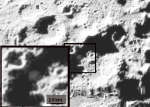 Water Discovered in Moon Shadow
18.11.2009
Why is there water on the Moon? Last month, the LCROSS mission crashed a large impactor into a permanently shadowed crater near the Moon's South Pole. A plume of dust rose that was visible to the satellite, although hard to discern from Earth. The plume is shown above in visible light.
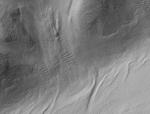 Young Martian Terrain
1.08.2001
What caused the pits, ridges, and gullies on otherwise smooth Martian terrain? One hypothesis is water. The lack of craters at this mid-latitude location indicates that the terrain is quite young by geological standards, perhaps only 100,000 years old.
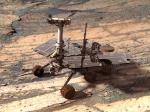 A Digital Opportunity Rover on Mars
14.12.2005
If you could see one of the robot rovers currently rolling across Mars, what would it look like? To gain this perspective useful in planning explorations, the above synthetic image was produced digitally. Above...
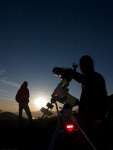 Star Party on Planet Earth
4.04.2009
As twilight sweeps around planet Earth tonight (April 4), many amateur astronomers will set up their telescopes for a 24-hour global star party. The planetwide star party is part of 100 Hours of Astronomy (100HA), a project of the International Year of Astronomy 2009.
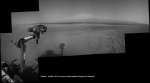 Curiosity on Mars: Mt Sharp in View
27.08.2012
What's that on the horizon? The light peak is Mt. Sharp -- an eventual destination of the Curiosity rover. The above image mosaic was taken from Bradbury Landing, the landing spot of Curiosity, and shows in the foreground the rover's extended robotic arm.
|
January February March April May June July August September October |
|||||||||||||||||||||||||||||||||||||||||||||||||