
|
You entered: galaxy center
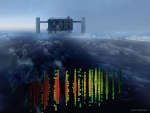 Distant Neutrinos Detected Below Antarctic Ice
1.09.2015
From where do these neutrinos come? The IceCube Neutrino Observatory near the South Pole of the Earth has begun to detect nearly invisible particles of very high energy. Although these rarely-interacting neutrinos pass through much of the Earth just before being detected, where they started remains a mystery.
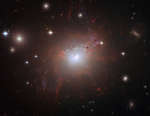 Active Galaxy NGC 1275
26.01.2023
Active galaxy NGC 1275 is the central, dominant member of the large and relatively nearby Perseus Cluster of Galaxies. Wild-looking at visible wavelengths, the active galaxy is also a prodigious source of x-rays and radio emission.
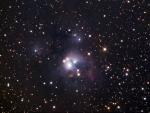 Young Suns of NGC 7129
11.08.2005
Young suns still lie within dusty NGC 7129, some 3,000 light-years away toward the royal constellation Cepheus. While these stars are at a relatively tender age, only about a million years old, it is likely that our own Sun formed in a similar stellar nursery some five billion years ago.
 XMM Launched
21.12.1999
X-ray astronomy entered a golden age earlier this month with the successful launch of the X-ray Multi-Mirror (XMM) satellite. XMM's three huge telescope barrels each hold 58 concentric cylindrical mirrors, together totaling a surface area rivaling a tennis court.
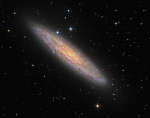 NGC 253: Dusty Island Universe
3.11.2016
Shiny NGC 253 is one of the brightest spiral galaxies visible, and also one of the dustiest. Some call it the Silver Dollar Galaxy for its appearance in small telescopes, or just the Sculptor Galaxy for its location within the boundaries of the southern constellation Sculptor.
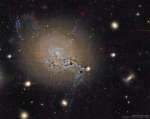 Filaments of Active Galaxy NGC 1275
5.04.2017
What keeps these filaments attached to this galaxy? The filaments persist in NGC 1275 even though the turmoil of galactic collisions should destroy them. First, active galaxy NGC 1275 is the central, dominant member of the large and relatively nearby Perseus Cluster of Galaxies.
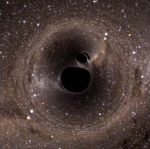 When Black Holes Collide
20.10.2015
What happens when two black holes collide? This extreme scenario likely occurs in the centers of some merging galaxies and multiple star systems. The featured video shows a computer animation of the final stages of such a merger, while highlighting the gravitational lensing effects that would appear on a background starfield.
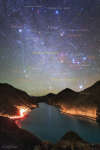 Winter Hexagon over Manla Reservoir
23.01.2017
If you can find Orion, you might be able to find the Winter Hexagon. The Winter Hexagon involves some of the brightest stars visible, together forming a large and easily found pattern in the winter sky of Earth's northern hemisphere.
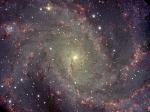 NGC 6946: The Fireworks Galaxy
25.01.2005
Why is this galaxy so active? Nearby spiral galaxy NGC 6946 is undergoing a tremendous burst of star formation with no obvious cause. In many cases spirals light up when interacting with another galaxy, but NGC 6946 appears relatively isolated in space.
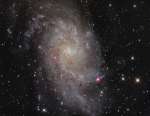 M33: Triangulum Galaxy
3.12.2010
The small, northern constellation Triangulum harbors this magnificent face-on spiral galaxy, M33. Its popular names include the Pinwheel Galaxy or just the Triangulum Galaxy. M33 is over 50,000 light-years in diameter, third largest in the Local Group of galaxies after the Andromeda Galaxy (M31), and our own Milky Way.
|
January February March April May June July August |
||||||||||||||||||||||||||||||||||||||||||||||||||||||||